Epilogue
Look Again
Chicago and London
Watch this chapter 1:03:12 in the filmRuns 3 min 48 s
Summary
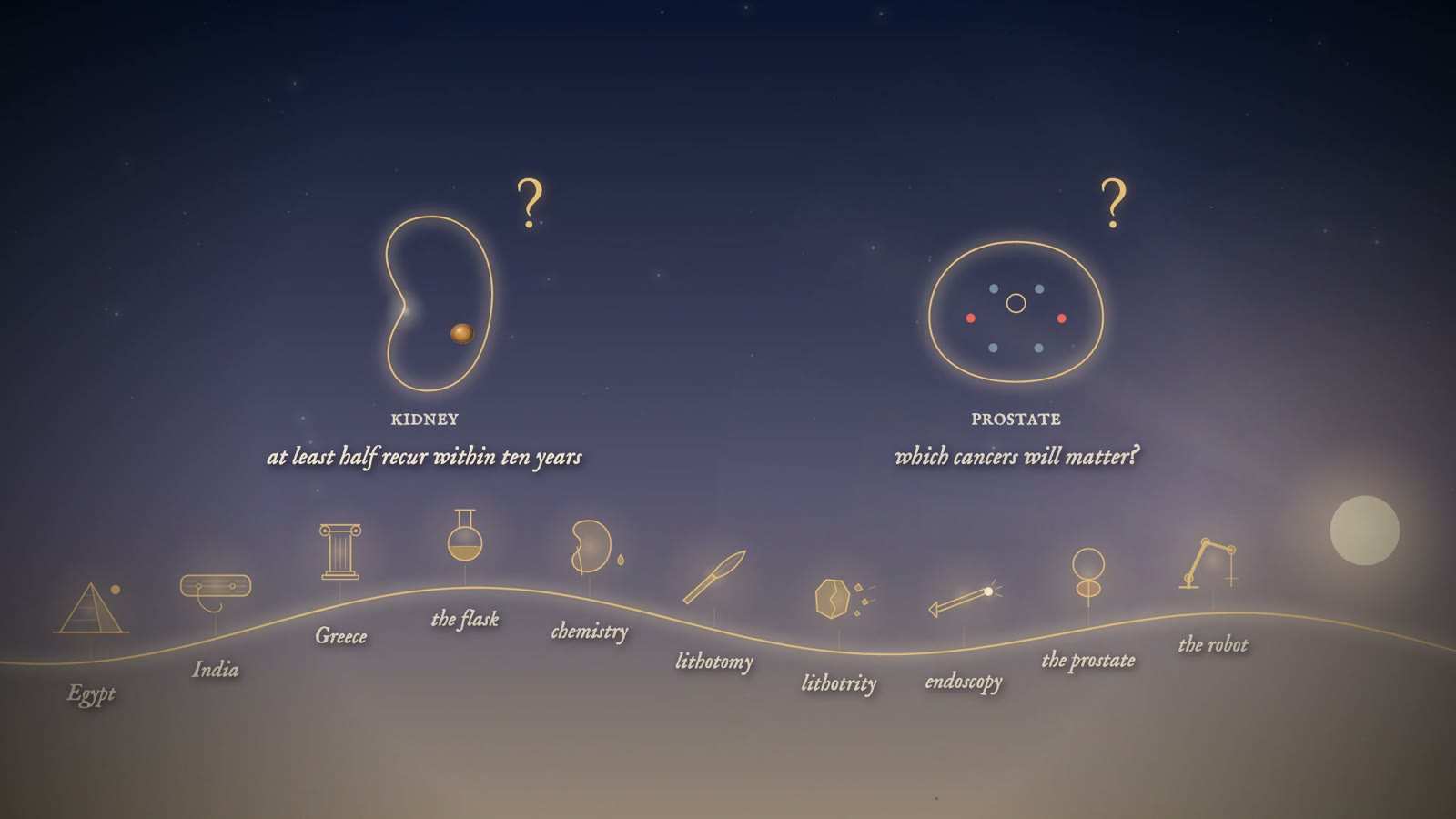
The epilogue closes both of the film's threads. The glass returns as a culture plate. For most of the twentieth century, healthy bladder urine was taught to be sterile, an inference rather than a finding. Edward Kass's threshold of 100,000 bacteria per millilitre, set in the 1950s, separated infection from contamination; it was not a test of sterility, and the routine culture that went with it, a thousandth of a millilitre grown in air for a day, could miss slow or demanding organisms. In 2012 Wolfe and colleagues found bacterial DNA in urine taken straight from the bladder by catheter and by suprapubic needle. In 2014 Hilt and colleagues, using a hundred times the usual volume, several atmospheres and longer incubation, grew bacteria from four in five catheter samples from women with and without overactive bladder; nearly all of these had been reported as no growth by the standard method. The stone returns as an absence. The El Amrah calculus, kept in the museum of the Royal College of Surgeons from about 1901, was destroyed when bombs struck the College in May 1941; in the words of the surgeon E. Riches, it was crushed and completely dispersed. The film ends on what is still unknown, including why stones form and recur in at least half of patients within ten years, and which prostate cancers matter, and on its working rule: look again.
Watch, shot by shot
-
-
-
-
-
What the film says, and the evidence
Verified claims are shown plain. probable means one reliable source; disputed means the sources disagree, and both versions are shown. Unverified material is not published here.
-
Hilt and colleagues (2014) wrote that a 'culture-negative' status had been equated with the dogma that normal urine is sterile. probable
SourcesThe film's 'for most of the twentieth century' is not stated in these sources (see gaps). In 1863, according to the French Wikipedia (citing the Comptes rendus, not read), Pasteur showed that fresh urine placed in sterilised air does not putrefy; that experiment did not sample the bladder.
-
In the 1950s Edward Kass set 100,000 bacteria per millilitre of clean-voided urine as the threshold separating true bacteriuria from contamination. probable
Sources- Wikipedia: Edward H. Kass Secondary
- E. H. Kass, Asymptomatic infections of the urinary tract (1956), reprinted as a classic in Journal of Urology 2002; 167(2 Pt 2):1016-1020 Primary
- E. H. Kass, Bacteriuria and the diagnosis of infections of the urinary tract, AMA Archives of Internal Medicine 1957; 100(5):709 (Crossref record 10.1001/archinte.1957.00260110025004) Primary
Papers of 1956 and 1957. The threshold is universally cited, but its primary text was not read for the kit. As the dossier notes, it separated infection from contamination and was not a test of sterility.
-
As described by Hilt and colleagues, the standard urine culture plates 0.001 mL of urine on blood and MacConkey agar in air at 35 °C for 24 hours, and detects 1,000 or more colony-forming units per millilitre.
-
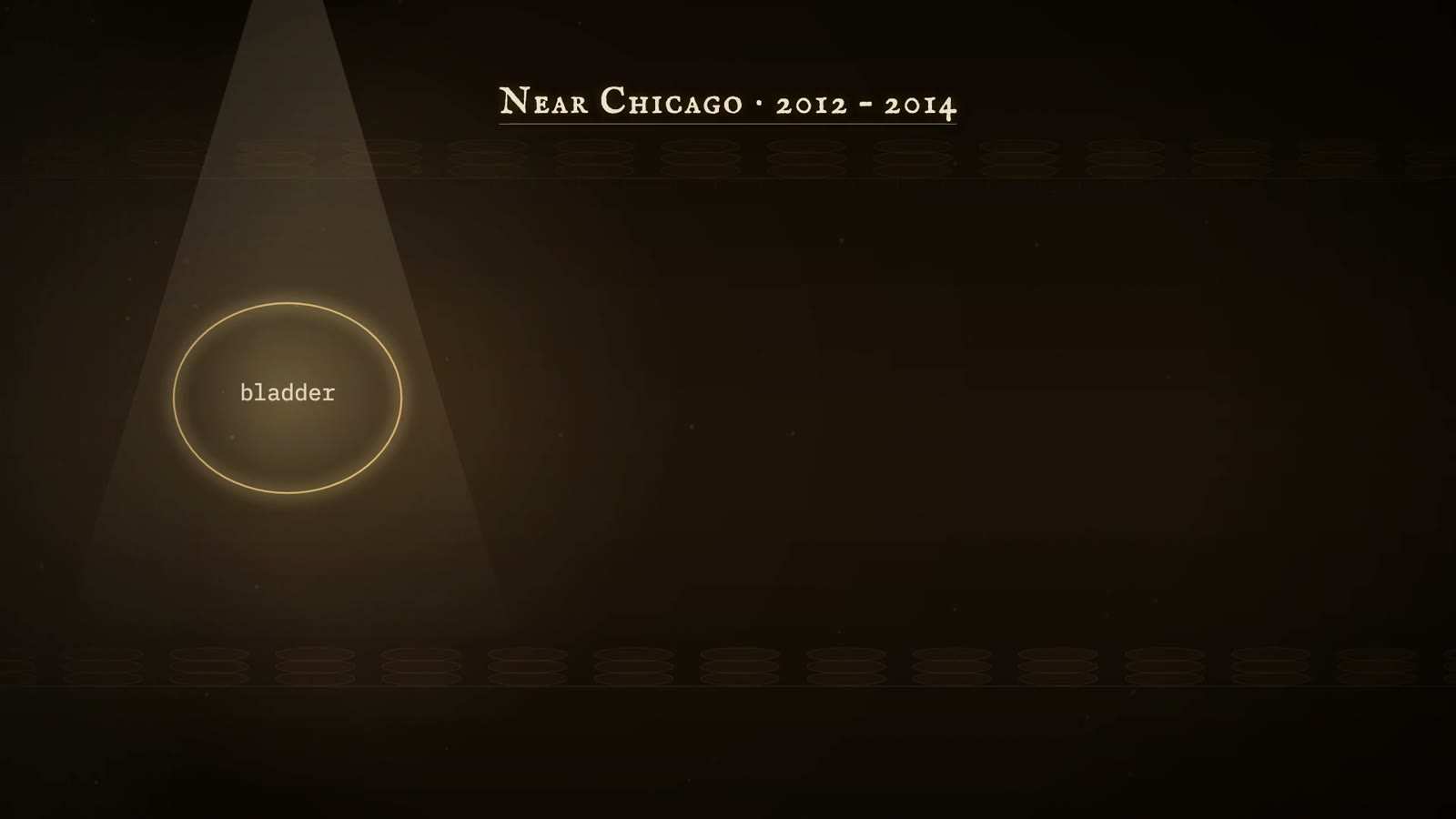
In 2012 Wolfe and colleagues took urine directly from the bladder by catheter and by suprapubic needle and found bacterial 16S rRNA genes in 21 of 23 suprapubic samples.
SourcesWomen without known urinary infection. The kit names the investigators' institution as Loyola but does not give its location (see gaps).
-
In 2014 Hilt and colleagues cultured catheter urine with an expanded method: 0.1 mL, a hundred times the standard volume, on several media, under several atmospheres, for 48 hours, with broth culture for five days.
-
Bacteria grew from 52 of the 65 catheter samples (80%), which came from 41 women with overactive bladder and 24 controls, and 48 of those 52 (92%) had been reported as 'no growth' by the standard method.
35 genera and 85 species were identified.
-
The investigators wrote that it remained unclear whether these bacteria were viable, or whether their presence was relevant to idiopathic urinary tract conditions.
Sources -
The El Amrah stone was presented to the museum of the Royal College of Surgeons of England in 1901 and was there until 1941. probable
SourcesEAU gives 1901 for the gift; Riches (1967) says the stone was in the museum until 1941. Each date rests on one of the cited sources, and the dossier grades the year of the find disputed: one source dates Elliot Smith's Egyptian work from 1902. The film's 'forty years' is a reckoning from these dates (see gaps).
-
In May 1941 the Royal College of Surgeons was hit in a bombing raid, and more than half of the specimens in its museum were destroyed.
Sources- Royal College of Surgeons of England: Brief College History Museum or society
- Hunterian Museum: the Hunterian collection Museum or society dead link
The exact night is not verified in the sources read. The two sources differ in detail (next claim).
-
Accounts of the May 1941 damage differ in detail. disputed
- Version 1
The College received several direct hits, and over half of the 60,000 specimens in the Hunterian Museum were destroyed, including two-fifths of Hunter's original collection (RCS history).
Sources- Royal College of Surgeons of England: Brief College History Museum or society
- Version 2
An incendiary bomb directly hit the College building and destroyed two-thirds of the collections (Hunterian Museum).
Sources- Hunterian Museum: the Hunterian collection Museum or society dead link
The film says 'bombs struck the College, and more than half of its specimens were destroyed'.
- Version 1
-
The stone was destroyed. In 1967 E. Riches said it had been 'effectively crushed and completely dispersed by enemy bombs'.
SourcesRiches spoke in his Arnott Demonstration at the Royal College of Surgeons; EAU says the stone was destroyed in a bomb attack in the Second World War. That it was long held to be the oldest bladder stone is a prologue claim.
-
Radiocarbon modelling places the start of Egypt's Predynastic (Naqada) culture at about 3800 to 3700 BC, and Naqada I is generally placed between about 4000 and 3500 BC. probable
SourcesThese are period dates. The El Amrah grave has no direct date and its Naqada phase is not confirmed, so the film's 'more than five thousand years' is a reckoning (see gaps, and the prologue's conflict on the stone's age).
-
At least half of people who have a kidney stone form another within ten years. probable
Sources- AUA guideline: Medical management of kidney stones (Pearle et al. 2014) Museum or society dead link
One source: the AUA guideline, citing Uribarri et al. (1989).
-
An autopsy study of White and Asian men found occult prostate cancer increasing with age, to nearly 60% in men older than 80. probable
SourcesOne secondary source: NCI PDQ, citing Zlotta et al. 2013. This bears on the film's 'which of its cancers will matter and which will sleep'.
Myths corrected
-
False. Normal urine in the bladder is sterile.
-
False. Below Kass's threshold of 100,000 bacteria per millilitre, urine is sterile.
-
Unsupported. Pasteur proved that urine in the bladder is sterile.