Prologue
A Stone in a Jar
Upper Egypt and a museum in London
Watch this chapter 0:00 in the filmRuns 2 min 13 s
Summary
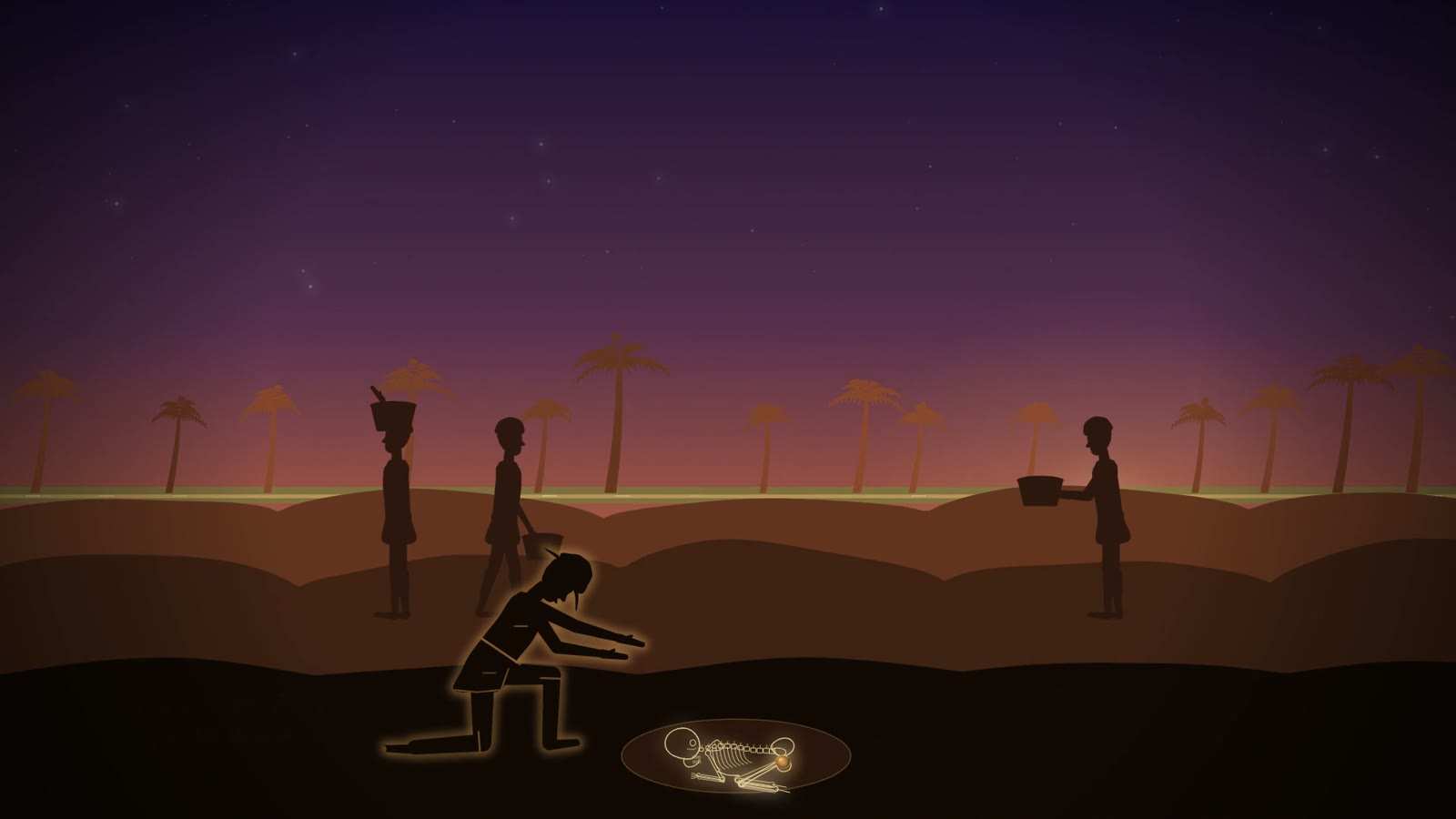
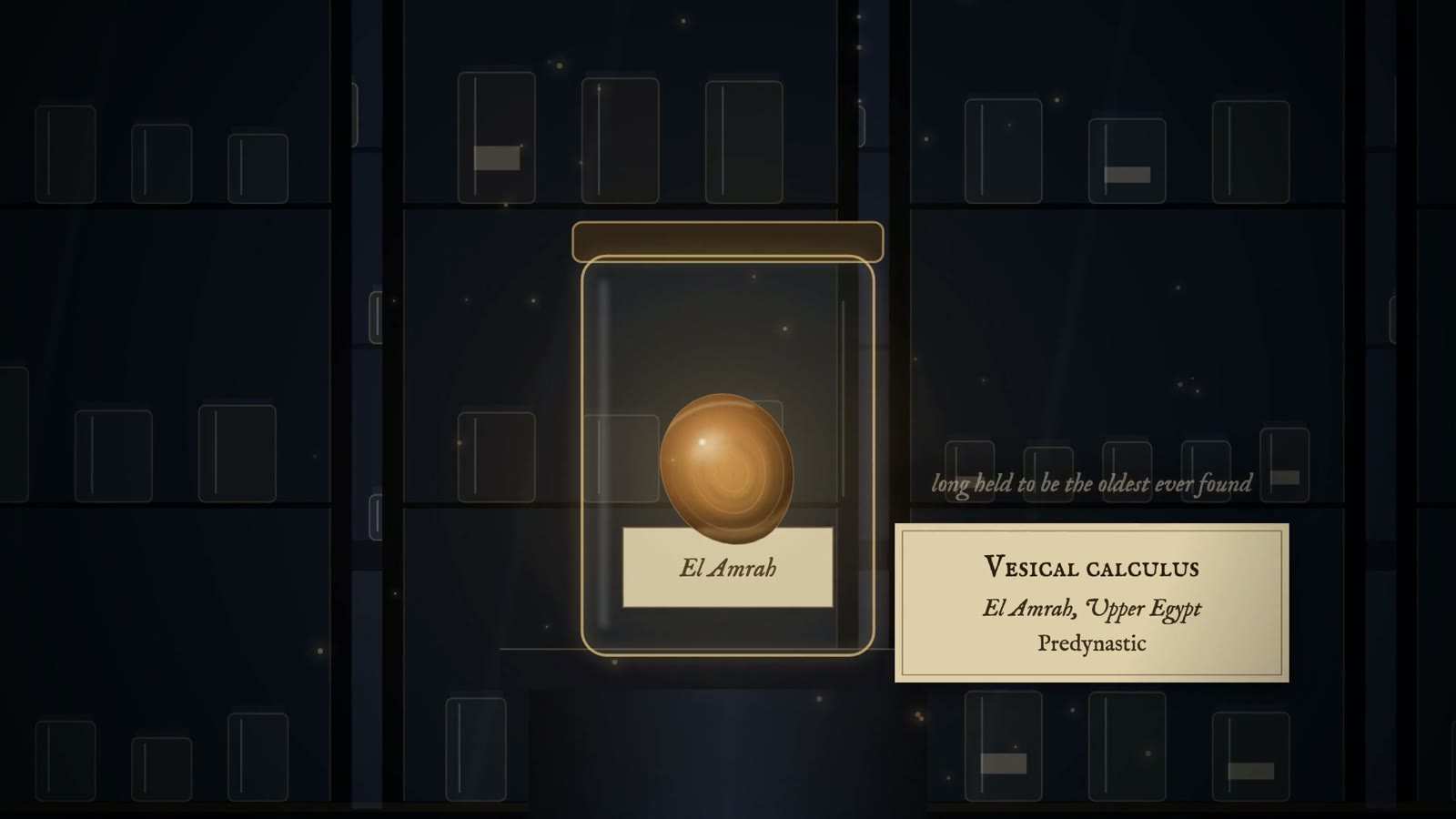
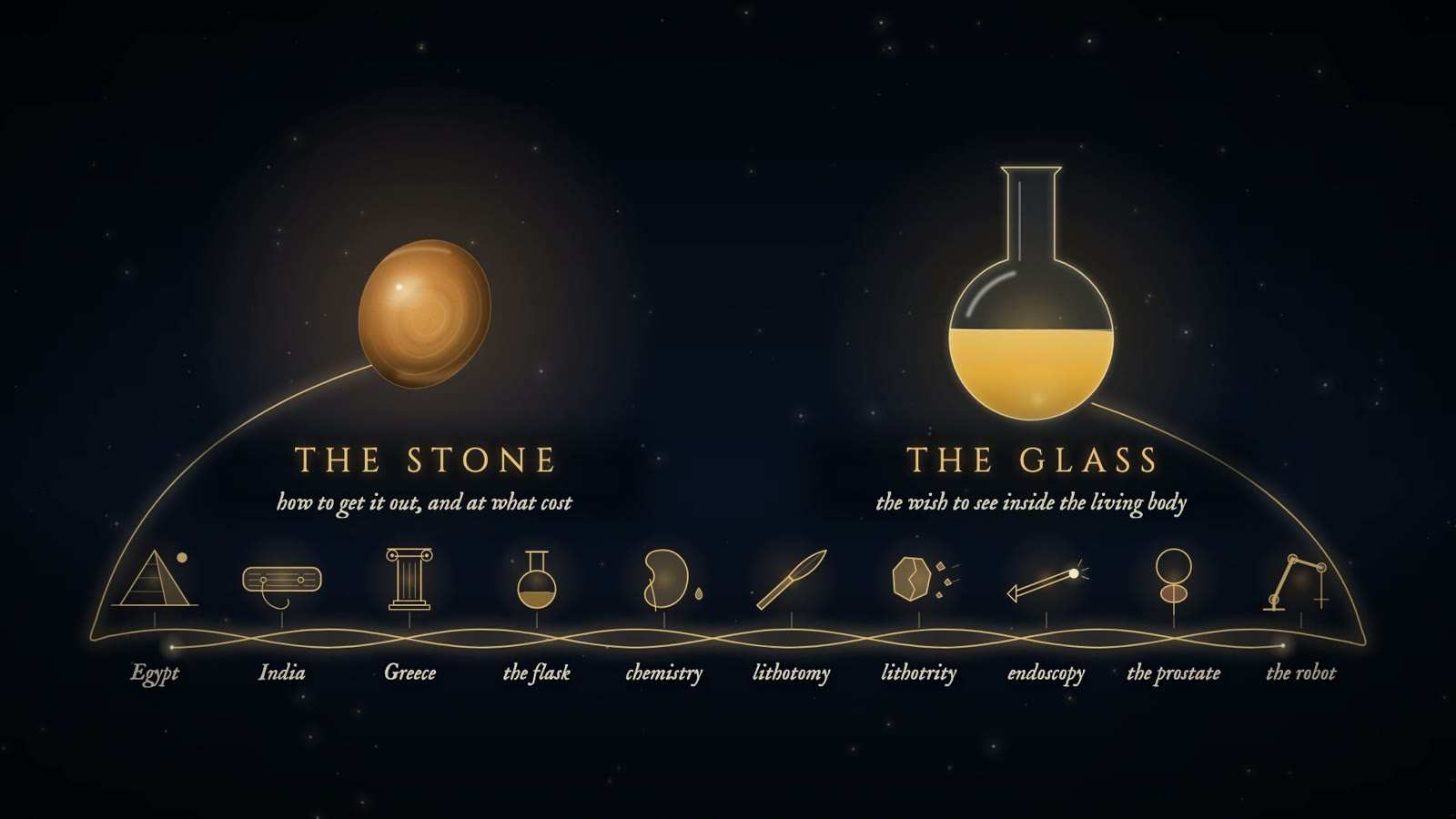
The film opens on an absence. A bladder stone from a predynastic grave at El Amrah, in Upper Egypt, once sat in a jar in the museum of the Royal College of Surgeons of England in London. The anatomist Grafton Elliot Smith, who had gone to the cemetery to examine ancient brains, found it in the pelvis of a boy's skeleton early in the twentieth century; in his own later account it lay in the first Egyptian grave he looked into. The stone went to the College museum, and S. G. Shattock described it to the Pathological Society of London in 1905. For decades it was taken to be the oldest bladder stone known. Its stated age has shrunk as the chronology of early Egypt has been revised: older sources give 4800 BC or more than 7,000 years, while radiocarbon modelling now places the start of the predynastic Naqada culture at about 3800 to 3700 BC. The film commits only to a burial before the first pharaoh, more than five thousand years ago. The prologue then sets out the film's two threads, the stone and the glass, and its working rule: a thing repeated is not a thing proven. The stone's fate, in the bombing of the College in May 1941, is told in the epilogue.
Watch, shot by shot
-

-
-
-
-
In their words
“In the first Egyptian grave that I looked into, I saw the skeleton of an Egyptian boy, in whose pelvis there was a large vesical calculus.”
As quoted in Waldron 2000; the 1926 magazine was not read, so the wording rests on one secondary source and is graded probable. Waldron's text has no comma after 'looked into'. An external fact-check proposed a 1930 wording from Elliot Smith's introduction to a translation of the Papyrus Ebers; the production kept the 1926 wording. See conflicts.
- G. Elliot Smith, The diversions of an anatomist in Egypt, Cambridge University Medical School Magazine 1926; 5:34-39 (as quoted in Waldron 2000) Primary
- Waldron 2000, The study of the human remains from Nubia (Medical History 44:363-388) Secondary
What the film says, and the evidence
Verified claims are shown plain. probable means one reliable source; disputed means the sources disagree, and both versions are shown. Unverified material is not published here.
-
A bladder stone from a predynastic grave at El Amrah, in Upper Egypt, was kept in the museum of the Royal College of Surgeons of England.
Sources- EAU History Office: Cutting for the Stone Museum or society
- Riches 1967, The history of lithotomy and lithotrity (Arnott Demonstration, RCS) Secondary
- Wikipedia: El-Amrah Secondary
The EAU History Office records that Elliot Smith presented the stone to the College museum in 1901; Riches (1967), speaking at the College, says it was in the museum there until 1941. The film's 'a museum in London' is not stated by these sources (see gaps).
-
The stone was a bladder stone, found in the pelvis of a boy's skeleton, and measured about 6.5 cm in diameter. probable
SourcesElliot Smith's own account, as quoted by Waldron, says 'boy'. The 6.5 cm diameter comes from one source (EAU), which also gives an age of 16; that age rests on secondary sources whose origin, probably Shattock 1905, was not read. The film's 'larger than a hen's egg', and the research dossier's comparison with a hen's egg, are not taken from a source (see conflicts and gaps).
-
The boy was buried in a predynastic grave; radiocarbon modelling places the start of the predynastic Naqada culture at about 3800 to 3700 BC. probable
Sources- Wikipedia: El-Amrah Secondary
- sci.news report of Dee et al. 2013 (radiocarbon chronology of early Egypt) Secondary
- Wikipedia: Naqada I Secondary
El Amrah is a predynastic cemetery and the site after which the Amratian (Naqada I) culture is named (Wikipedia); Wikipedia places Naqada I at about 4000 or 3900 to 3600 BC, or 3750 to 3500 BC. No source dates the grave itself, so the film's 'before the first pharaoh, more than five thousand years ago' is the research dossier's inference, not a source statement (see gaps). The EAU and BAUS give 4800 BC and Riches more than 7,000 years; the dossier judges these to follow older chronologies.
-
The stone was found by the anatomist Grafton Elliot Smith at the start of the twentieth century; he had gone to the El Amrah cemetery to examine ancient brains.
SourcesW. H. R. Rivers, working in Upper Egypt, told Elliot Smith that skulls being uncovered held well-preserved brains (Waldron, citing Elliot Smith 1926). Elliot Smith had taken the Cairo chair of anatomy in October 1900.
-
The film places the find at the start of the twentieth century; sources differ on the year. disputed
- Version 1
1901: the EAU History Office says Elliot Smith presented the stone to the museum of the Royal College of Surgeons in 1901, and the Didusch Museum newsletter also gives 1901.
Sources- EAU History Office: Cutting for the Stone Museum or society
- Didusch Museum newsletter: Breaking the Stone Age (2025) Museum or society
- Version 2
Elliot Smith's Egyptological work began in 1902, when he was asked to examine ancient brains from El Amrah.
Sources
Waldron (2000) implies a find soon after Elliot Smith took up the Cairo chair of anatomy in October 1900, and Wikipedia gives the El Amrah excavation as 1899 to 1901. The research dossier's best reading is 1901.
- Version 1
-
In his own account, the first Egyptian grave Elliot Smith looked into held a boy's skeleton with a large bladder stone in the pelvis. probable
Sources- G. Elliot Smith, The diversions of an anatomist in Egypt, Cambridge University Medical School Magazine 1926; 5:34-39 (as quoted in Waldron 2000) Primary
- Waldron 2000, The study of the human remains from Nubia (Medical History 44:363-388) Secondary
Known only as quoted by Waldron (2000) from Elliot Smith (1926); the 1926 magazine was not read, so the account rests on one secondary source and is graded probable. An external fact-check proposed a different wording from 1930; the production kept the 1926 wording. See conflicts.
-
Elliot Smith wrote that the stone was several millennia older than any other recorded case of stone in the bladder. probable
Sources- G. Elliot Smith, The diversions of an anatomist in Egypt, Cambridge University Medical School Magazine 1926; 5:34-39 (as quoted in Waldron 2000) Primary
- Waldron 2000, The study of the human remains from Nubia (Medical History 44:363-388) Secondary
- Riches 1967, The history of lithotomy and lithotrity (Arnott Demonstration, RCS) Secondary
Elliot Smith (1926), as quoted by Waldron (2000); the 1926 text was not read. Riches (1967) gave the stone's age as more than 7,000 years. No source read says how long the stone was held to be the oldest, so the film's 'long held to be the oldest bladder stone ever found' goes beyond the sources (see gaps).
-
The stone no longer exists: bombs destroyed it during the Second World War, while it was in the College museum.
Sources- Riches 1967, The history of lithotomy and lithotrity (Arnott Demonstration, RCS) Secondary
- Royal College of Surgeons of England: Brief College History Museum or society
- Hunterian Museum: the Hunterian collection Museum or society dead link
- EAU History Office: Cutting for the Stone Museum or society
Riches gives the year as 1941; the EAU says only that it was destroyed in a bomb attack in the Second World War. The RCS history and the Hunterian Museum record that the College was hit in a bombing raid in May 1941 but do not name the stone, so no source read gives the month for the stone itself (see gaps). The prologue promises the explanation, which the epilogue gives.
Myths corrected
-
Outdated. The El Amrah stone dates from 4800 BC, or is more than 7,000 years old.
-
False. The stone came from the mummy of a teenage boy known as 'El-Amrah', found in northern Egypt.