Chapter III
The Oath and the Ligature
Greece, Alexandria and Rome, 400 B.C. to A.D. 200
Watch this chapter 7:55 in the filmRuns 6 min 50 s
Summary
Chapter III runs from the Hippocratic writers to Galen. The Hippocratic texts read urine as one sign among others: an aphorism links bubbles on the urine to kidney disease, now read as protein loss, and another text explains that women form fewer stones because the female urethra is short and wide. The Oath contains a clause on cutting for the stone. In Adams's 1849 translation the physician leaves that operation to its practitioners; Jones's 1923 version renounces the knife more widely. The question is unsettled. In Alexandria, Ammonius held a stone too large to extract at the wound and split it, an idea the film follows to later lithotrity. Celsus, whose life Riches dates to about 25 BC to AD 50, set out the perineal lithotomy later called the lesser apparatus: spring only, boys of nine to fourteen, two fingers in the rectum, a crescent cut. He also listed bronze catheters, a little curved, and a bronze male catheter has been recovered at Pompeii. The chapter ends with Galen's ligature experiment on the ureters of a living animal, which showed that the kidneys supply the bladder and that urine does not run back up the ureters, and with his theory that the kidney draws urine from the blood as a lodestone draws iron. He explicitly rejected the sieve.
Watch, shot by shot
-
-
-
-
-
-
-
-
In their words
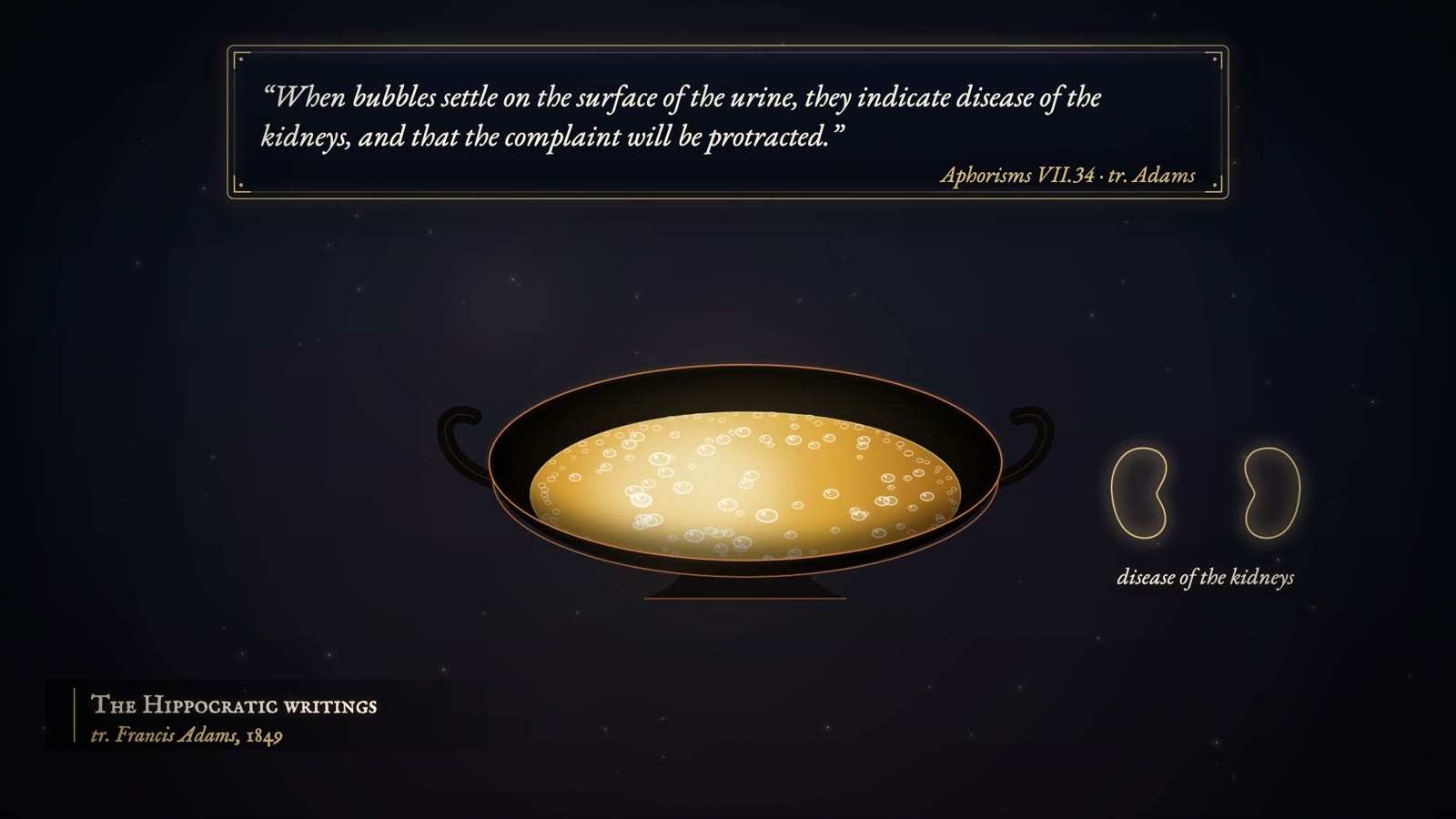
“When bubbles settle on the surface of the urine, they indicate disease of the kidneys, and that the complaint will be protracted.”
Read on the MIT Internet Classics Archive, which gives no date for the translation; the research dossier assigns it to Adams's Genuine Works of Hippocrates (Sydenham Society, 1849) without a source (see gaps). The date of the Greek original is not verified in the kit.
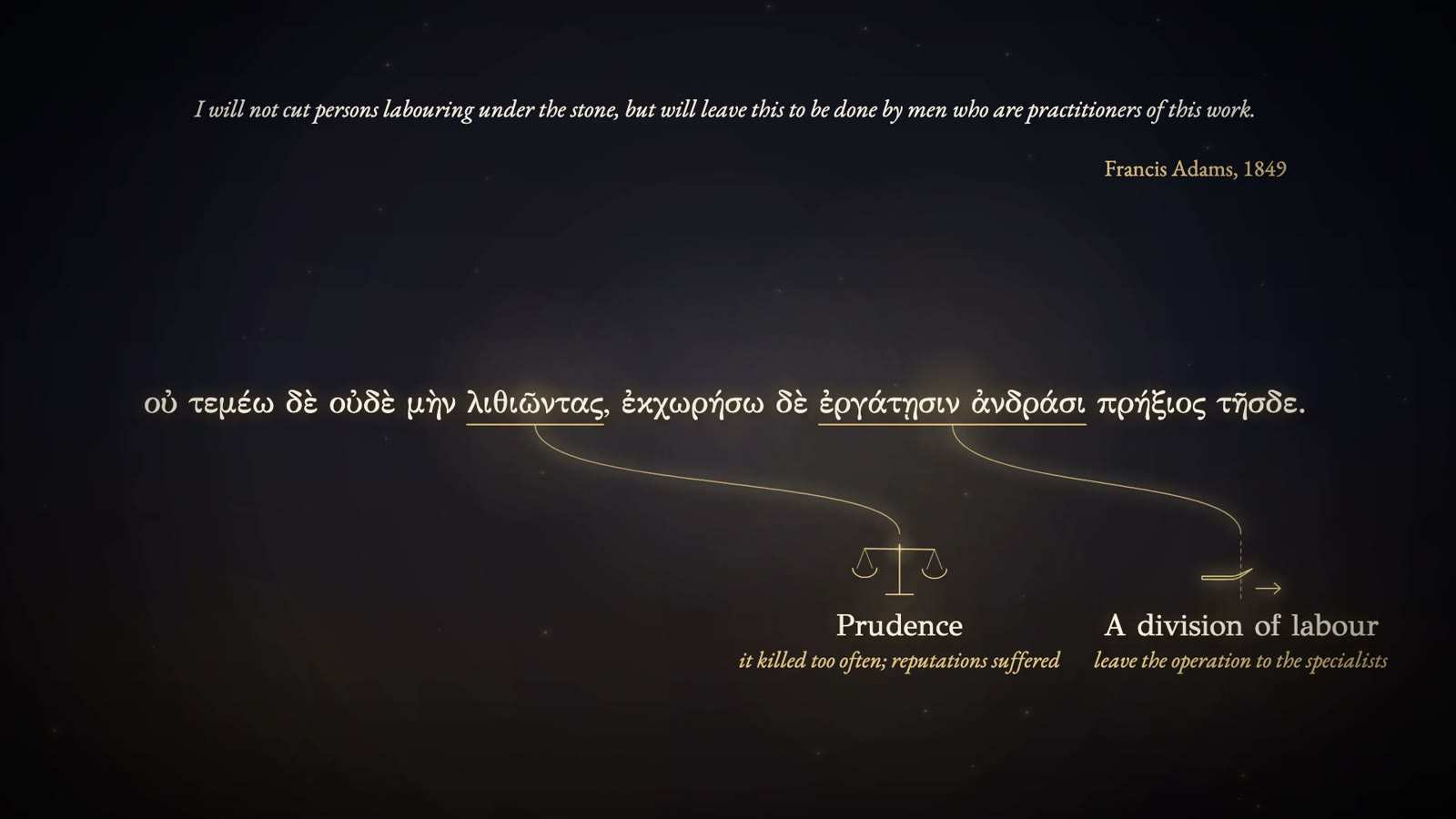
“I will not cut persons labouring under the stone, but will leave this to be done by men who are practitioners of this work.”
The online text read for the film (MIT Internet Classics Archive) spells it 'laboring' and gives no date for the translation; the film's 'labouring' and the 1849 date given in the research dossier are not checked against the printed edition (see gaps). Jones's 1923 translation reads the clause more widely. See debates.
“One has to divide the peritoneum in front of the ureters, then secure these with ligatures, and next, having bandaged up the animal, let him go.”
Abridged: the film omits Brock's parenthesis that the animal will not continue to urinate. The passage does not name the species.
“One loosens the external bandages, and shows the bladder empty, and the ureters quite full and distended, in fact almost on the point of rupturing.”
Brock's sentence begins 'After this one loosens'; the film drops 'After this' and adjusts the punctuation.
“On removing the ligature from them, one then plainly sees the bladder becoming filled with urine.”
The same sentence continues in Brock; the film starts a new line here.
“Like slaves, then, caught in the act of stealing, these two are quite bewildered; and while the one says nothing, the other indulges in shameless lying.”
'These two' are Erasistratus, who says nothing about how the kidney separates urine, and Asclepiades, who lies. Brock has a comma after 'bewildered' where the film has a semicolon.
What the film says, and the evidence
Verified claims are shown plain. probable means one reliable source; disputed means the sources disagree, and both versions are shown. Unverified material is not published here.
-
The Hippocratic Aphorisms tie signs in the urine to disease: blood or pus to ulceration of the kidneys or bladder, a sandy sediment to calculus, and bubbles on the surface to disease of the kidneys with a protracted course.
SourcesAphorisms IV.75, IV.79 and VII.34, tr. Adams. The film's dating of the Hippocratic writers to four or five centuries before Christ is not verified in the kit (see gaps).
-
A Hippocratic text says that stones do not form so readily in women, because in them the urethra is short and wide and the urine is easily expelled.
SourcesAirs, Waters, and Places part 9, tr. Adams.
-
The Oath contains a clause in which the physician swears not to cut persons with stone and to leave the work to its practitioners.
SourcesThe film quotes Adams's translation.
-
The stone clause can be read as a narrow ban on cutting for stone, left to specialists, or as a wider renunciation of the knife. disputed
- Version 1
A narrow ban: Adams's translation leaves cutting for stone to 'men who are practitioners of this work', a division of labour with specialists.
- Version 2
A wider renunciation: Jones's 1923 translation has the physician not use the knife, 'not even, verily, on sufferers from stone'.
Sources
The film says the argument has never been settled; no source in the kit states that directly. The film also names prudence and a Pythagorean origin among the readings. The kit does not verify who proposed those readings, so they are not shown here.
- Version 1
-
For much of the following history, in Europe at least, cutting for the stone was left largely to a separate trade of travelling stone-cutters. probable
Riches (1967) says that those who actually did the operation were itinerant lithotomists, physicians thinking it beneath them, and records the Collot family of lithotomists over eight generations. The EAU page formerly cited here calls Pierre Franco a barber-surgeon but does not describe a separate trade, and was dropped after the audit. The research dossier treats the medieval part of the claim as background knowledge (see gaps).
-
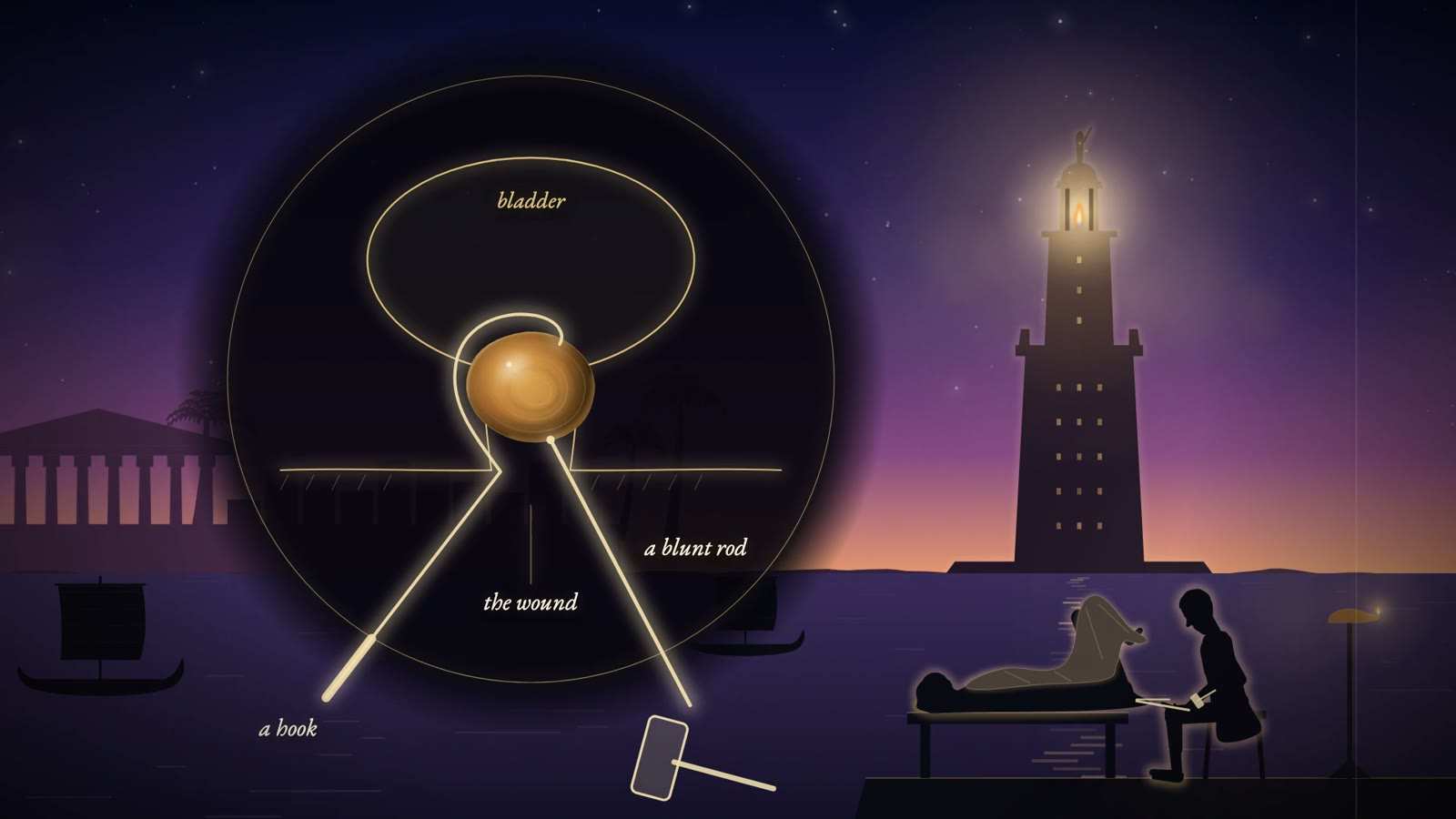
Celsus records that Ammonius, surnamed lithotomus, dealt with a stone too large to remove whole by holding it with a scoop and splitting it with a struck instrument.
SourcesCelsus, tr. Spencer, calls the holding instrument a scoop; the film says a hook (see conflicts). Celsus warns that the instrument must not touch the bladder and that no fragment of the broken stone may cut into it. He describes splitting the stone at the perineal wound, not crushing through the urethra.
-
Sources differ on why Ammonius was surnamed lithotomus. disputed
- Version 1
Celsus ties the surname to the splitting process that Ammonius devised.
Sources - Version 2
Riches says the surname came from the instrument Ammonius invented to break a stone too large to pass through a perineal incision.
The film glosses the name as 'the stone-cutter'; the research dossier records that reading as the usual one but gives no source for it.
- Version 1
-
Riches places Ammonius in Alexandria, practising lithotomy in about 200 BC. probable
Only Riches dates and places him; the film's 'perhaps two centuries before Christ' reflects the single source. The research dossier's mention of writers who give the 3rd century BC has no source.
-
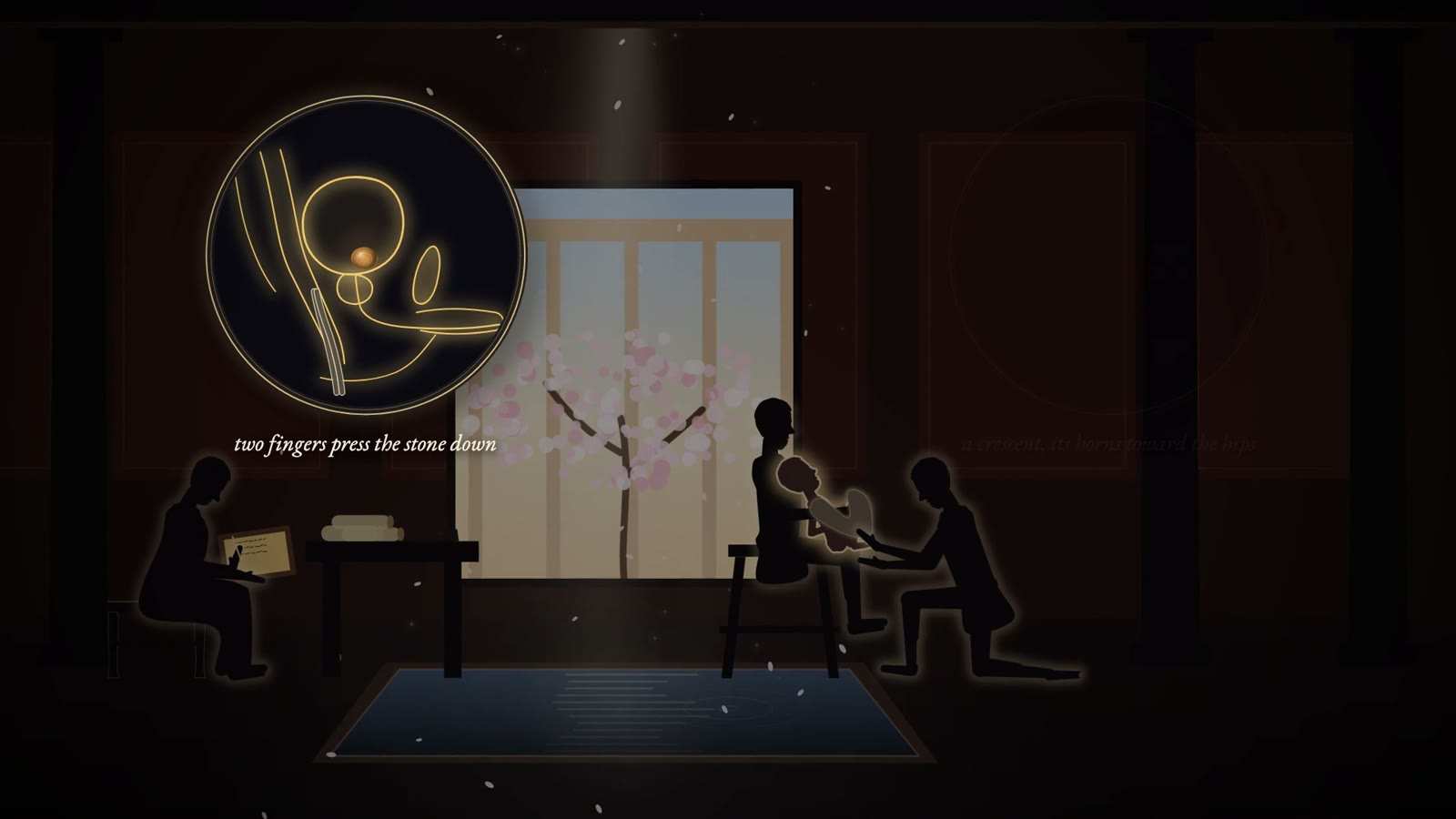
Celsus's De Medicina (7.26) sets out the perineal lithotomy: who may be cut and when, the position, how the stone is found, and the incision.
SourcesRiches gives Celsus's life as about 25 BC to AD 50 (probable). The film's 'Roman writer' and 'in full', and its 'probably in the time of the Emperor Tiberius', rest on details not verified in the kit (see gaps).
-
Celsus allows the operation only in spring and only in a boy aged between nine and fourteen.
SourcesDe Medicina 7.26, tr. Spencer.
-
A strong assistant on a high stool holds the child on his knees; the surgeon, nails pared, finds the stone with two fingers in the rectum, presses it down and makes a crescent-shaped cut over it.
SourcesSpencer's translation and the older public-domain translation quoted by Riches agree on the position, the two fingers of the left hand and the semilunar incision with its horns toward the hips.
-
The Celsian operation is known as the apparatus minor, in contrast to the Marian apparatus major, devised around 1520 and set out by Mariano Santo in 1535. probable
SourcesThe research dossier reckons a span of about fifteen hundred years from Celsus's dates to the Marian method; no source read states the span, or that the Celsian operation was the standard one in Europe (see gaps). The film's 'one knife, one hook, and speed' is not sourced in detail (see gaps).
-
For retention of urine Celsus describes bronze tubes, three lengths for men and two for women, 'a little curved, but more so for men'.
SourcesMen: 15, 12 and 9 finger-breadths; women: 9 and 6. Celsus does not call them S-shaped.
-
A male catheter found at Pompeii is known from a bronze cast made in 1903, now in the Penn Museum. probable
Sources- Penn Museum MS3594: cast of a male catheter found at Pompeii Museum or society
Penn Museum MS3594; the cast is 30.5 cm long. The film's 'bronze catheters have been dug from the ashes of Pompeii' speaks of more than one, of bronze; the kit verifies only this one object, known through its cast, and Mayall (2015) lists no catheters among the instruments from the House of the Surgeon (see gaps).
-
Asclepiades taught that drink passes into the bladder as vapour and condenses there, giving the kidneys no part in it.
SourcesGalen's report, On the Natural Faculties I.13. The film's 'some two centuries before Galen' and 'he still had followers' are not verified in the kit (see gaps).
-
Galen answered that vapours rise while the bladder lies below, and that practically every butcher knows what the kidneys do, since he sees daily the duct that runs from each kidney into the bladder.
On the Natural Faculties I.13, tr. Brock. The film's 'any butcher' is stronger than Brock's 'practically every butcher' (see conflicts).
-
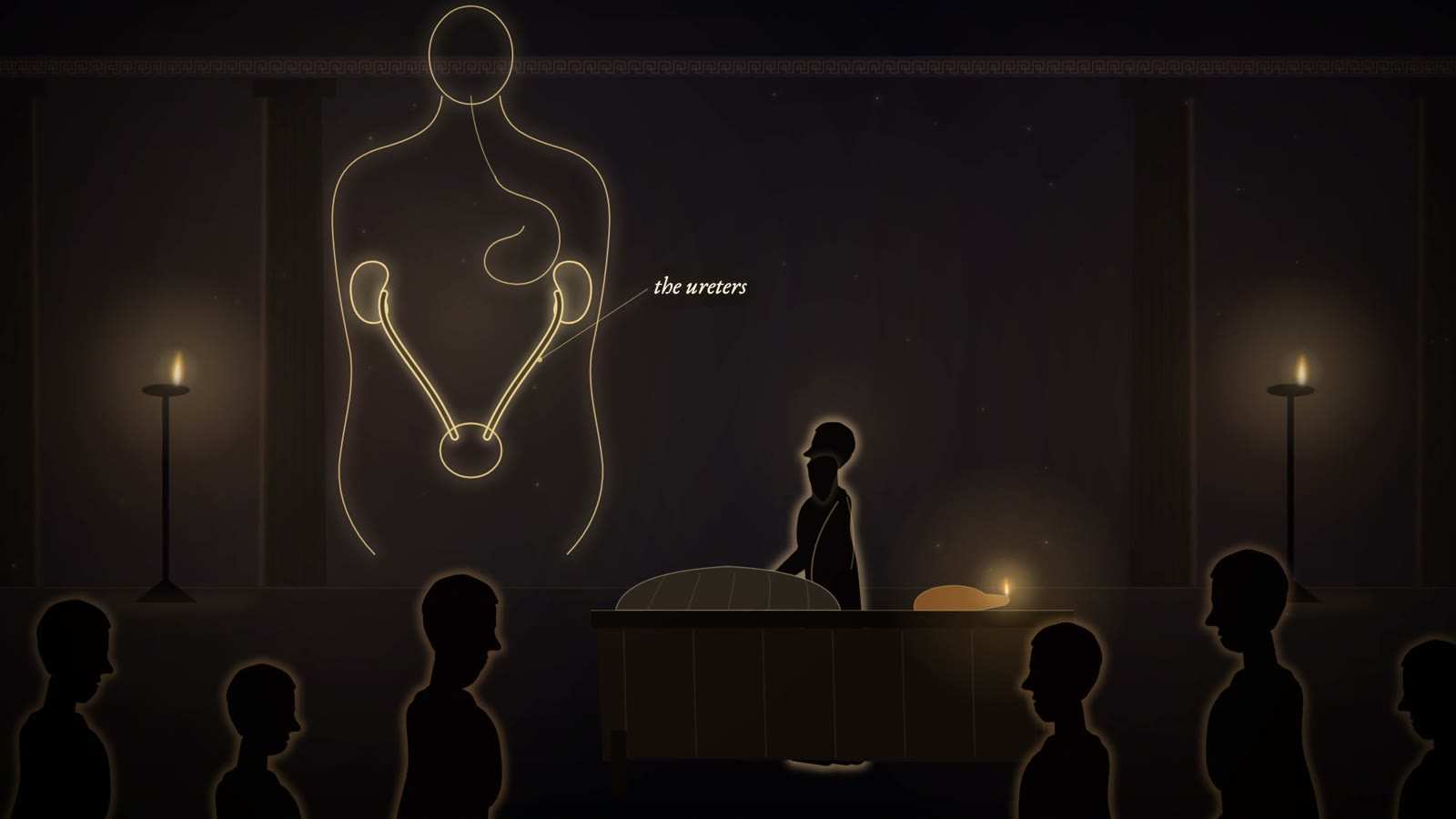
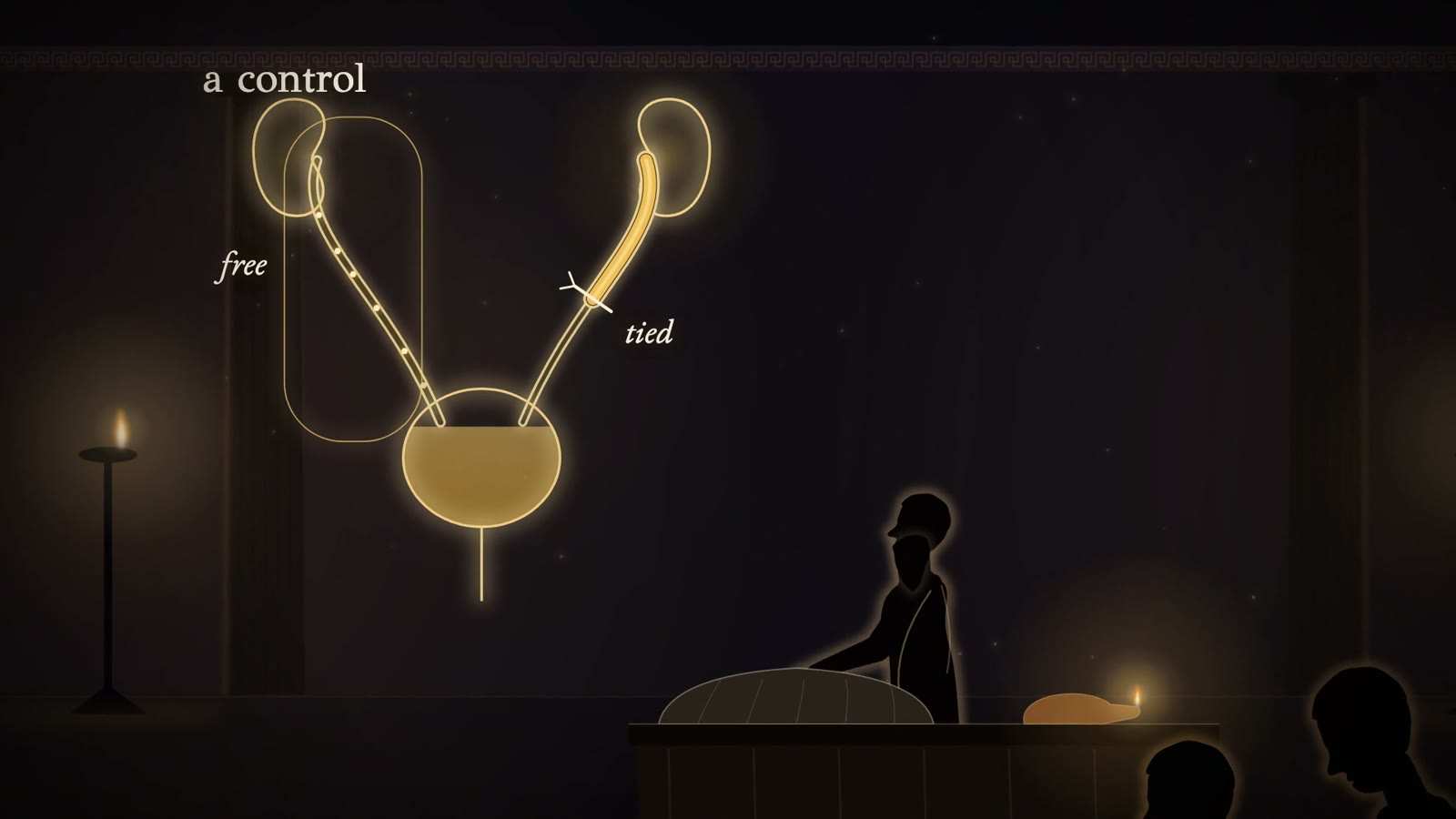
With both ureters tied in a living animal, the animal stopped passing urine, the bladder stayed empty and the ureters swelled; when the ligatures were removed, the bladder filled.
SourcesOn the Natural Faculties I.13. The species is not named.
-
With the penis tied and the full bladder squeezed, nothing passed back up the ureters toward the kidneys.
Sources -
With one ureter tied and the other free, the tied ureter became distended on the kidney side, while the free one was flaccid and had filled the bladder.
SourcesOn the Natural Faculties I.13, tr. Brock. The film and the research dossier call this a control; that is their reading of the design, not Galen's word (see gaps).
-
When Galen cut the distended ureter, urine spurted out like blood in venesection.
He then cut the other ureter; later the bladder was empty and urine had collected in the abdomen, as if the animal had dropsy.
-
Galen likened Asclepiades and Erasistratus to slaves caught stealing: one says nothing, the other lies.
On the Natural Faculties I.16.
-
Erasistratus worked in Alexandria with Herophilus; both performed systematic human dissection. probable
Sources- Wikipedia: Herophilos Secondary
The film's 'both long dead' depends on life dates not verified in the kit.
-
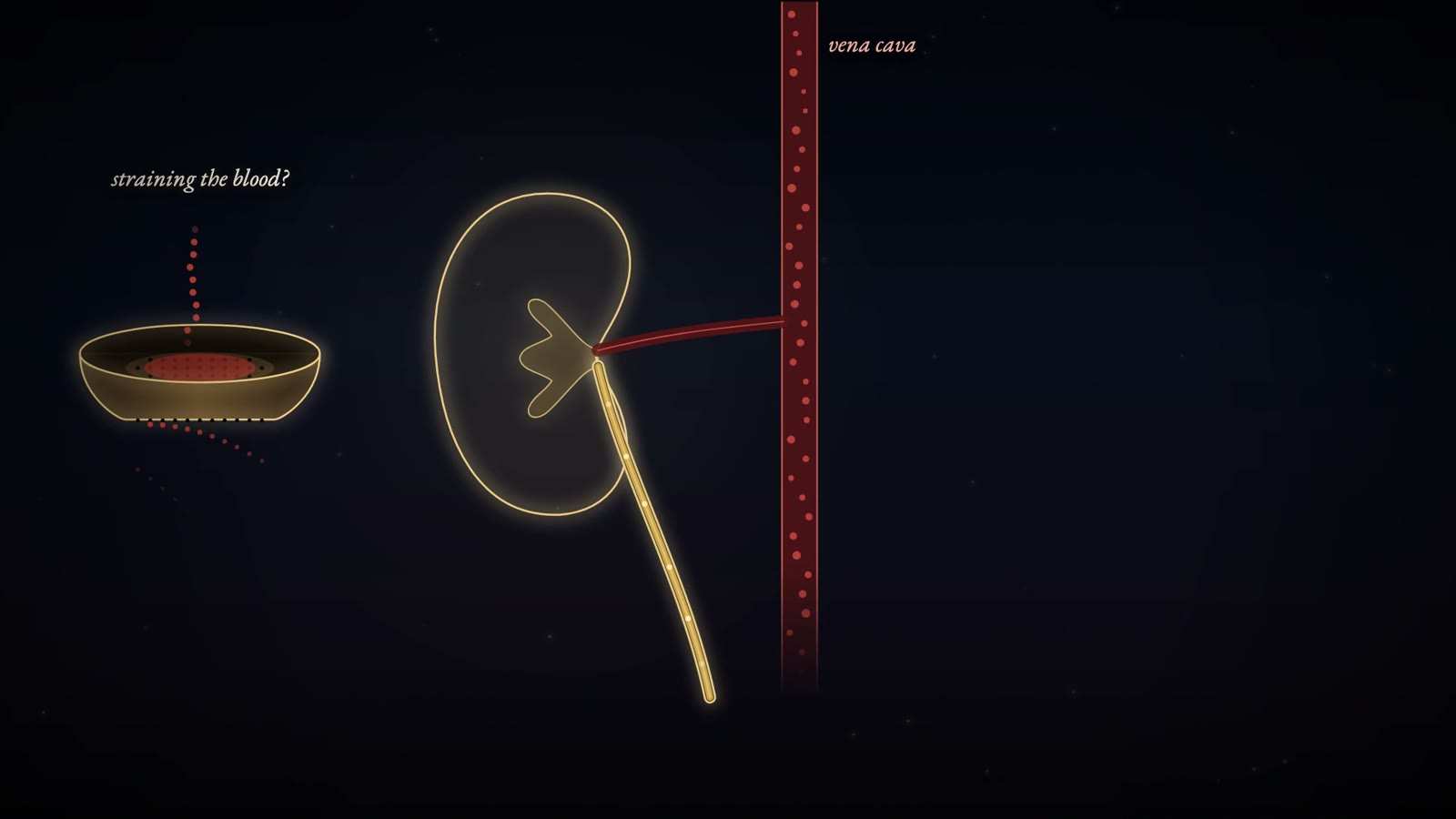
Galen rejected the idea that the kidney strains the blood like a sieve; he held that it draws the watery part of the blood to itself, as a lodestone draws iron.
SourcesSieve rejected at I.15; lodestone at I.14. A filtration theory returned in the 19th century with Carl Ludwig.
Myths corrected
-
Unproven. The Hippocratic Oath forbade doctors to do surgery.
-
False. Ammonius crushed bladder stones through the urethra.
-
False. Celsus described an S-shaped catheter.
-
Unsupported. Catheters were found in the House of the Surgeon at Pompeii.
-
Unsupported. The Romans invented the catheter.
-
Unsupported. Galen's ureter experiment was done on a pig (or a dog).
-
False. Galen proved that the kidney is a filter.