Chapter II
The King's Permission
India, the Sushruta Samhita
Watch this chapter 4:27 in the filmRuns 3 min 28 s
Summary
Chapter II reads the Sanskrit surgical text that bears the name of Sushruta, in Kaviraj Kunja Lal Bhishagratna's English translation. Its date is disputed: tradition places Sushruta around 600 BC, while the film describes a text compiled over many centuries and avoids a single date. The text sorts urinary stones into four kinds, three by the humours and one from semen, and says a phlegm stone may reach the size of a hen's egg. Medicines come first. If they fail, the text warns that death is almost certain without operation and the result of operation uncertain, so the surgeon should operate only with the king's permission. The lithotomy is set out precisely: two fingers of the left hand in the rectum bring the stone forward, a fist on the left of the belly holds it, and the cut is made on the left of the perineal raphe, a barley-corn's breadth from it. The text records that several authorities cut on the right. Aftercare is a warm bath in a cauldron, a treacle drink and a dressing of honey and clarified butter. No survival figures are given. For a narrowed urinary outlet the text prescribes ghee-smeared tubes, changed for thicker ones every third day: graduated dilation. Whether that condition is a urethral stricture or a tight foreskin is read both ways.
Watch, shot by shot
-
-
-
-
-

In their words
“The death of the patient is almost certain without a surgical operation, and the result to be derived from it is also uncertain.”
Bhishagratna vol. II p. 388 (his verses 11-12). The film adds a comma after 'operation'. Archive.org metadata dates vol. II to 1907 and the credits give 1907 to 1916; see conflicts.
“A skilled surgeon should perform such operations only with the permission of the king.”
Bhishagratna vol. II p. 388 (his verses 11-12). The research transcription begins with a lower-case 'a', so the line is an excerpt.
What the film says, and the evidence
Verified claims are shown plain. probable means one reliable source; disputed means the sources disagree, and both versions are shown. Unverified material is not published here.
-
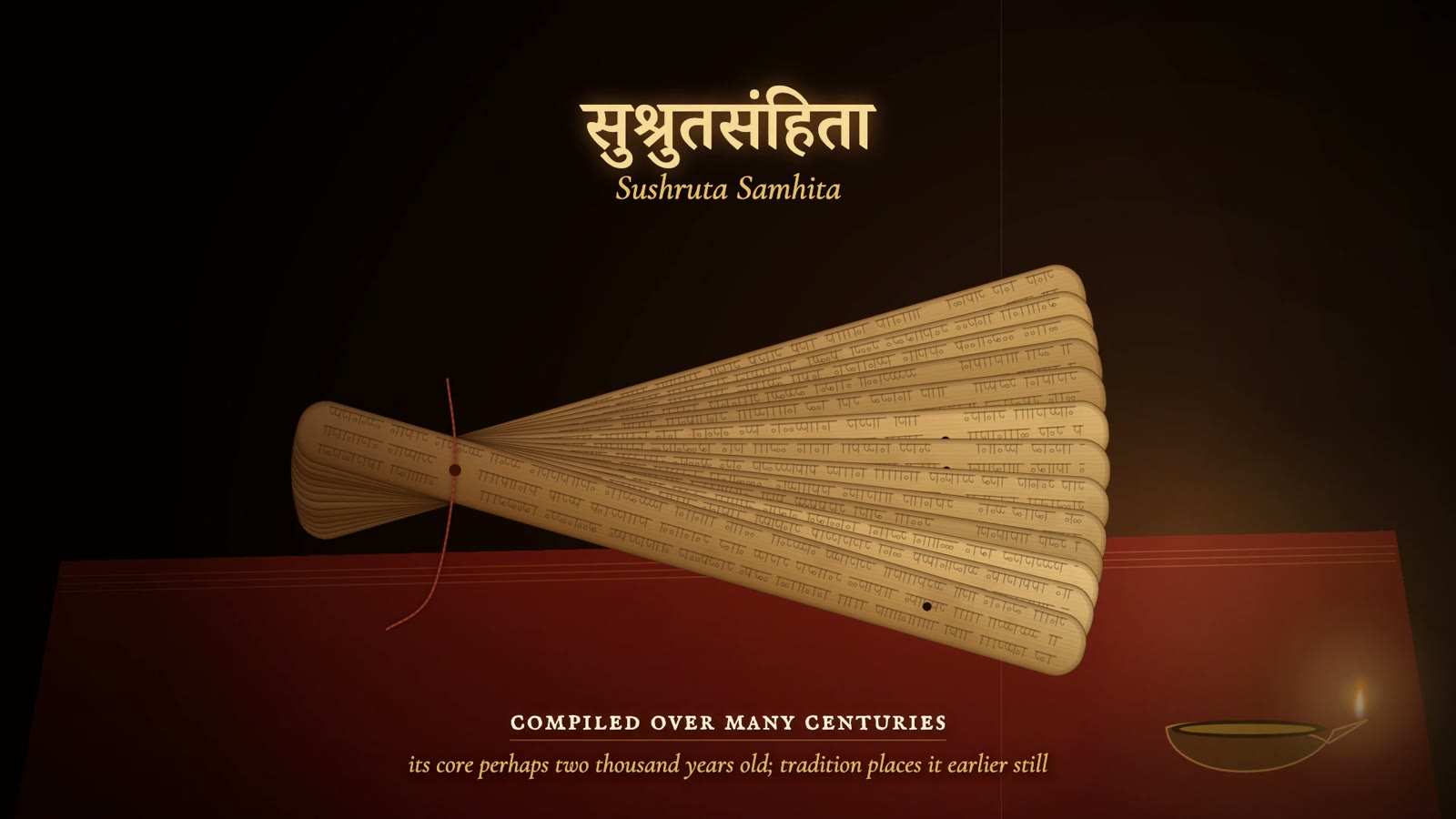
The Sushruta Samhita, a text that bears Sushruta's name, describes surgical operations, among them cutting for the stone.
The lithotomy is in Chikitsita Sthana ch. VII (Bhishagratna vol. II pp. 386 to 393). The film's 'great Sanskrit book' and 'a great many operations' are not stated in the passages read (see gaps).
-
The Didusch Museum newsletter places the text within a span from about 600 BC to AD 600. probable
Sources- Didusch Museum newsletter: Breaking the Stone Age (2025) Museum or society
The film's 'compiled over many centuries; its core may be two thousand years old, and tradition places it earlier still' rests on scholarly dating (Wujastyk; Meulenbeld) and a traditional date of about 600 BC that the research dossier records from background knowledge only (see gaps). Both earlier versions of this entry rested on the one Didusch source, so it is no longer shown as a dispute. The film avoids '600 BC' as fact.
-
A chapter of the Nidana Sthana (ch. 3) deals with the diagnosis of urinary stones, and the text describes a kind of stone that originates from kapha. probable
SourcesThe chapter's subject is known from the title of an EasyAyurveda page, which was not opened; the kapha stone is in Bhishagratna vol. II p. 82. The film's scheme of four kinds, three by the humours and one from semen, is recorded in the research dossier from background knowledge only (see gaps). Matching the types to modern stone compositions is a modern reading.
-
The text describes a kapha-originated stone as white and glossy, able to grow as large as a hen's egg.
Bhishagratna vol. II p. 82. The film's 'stone of phlegm' uses the research dossier's gloss for kapha (§3.2), not the translation's word in this passage.
-
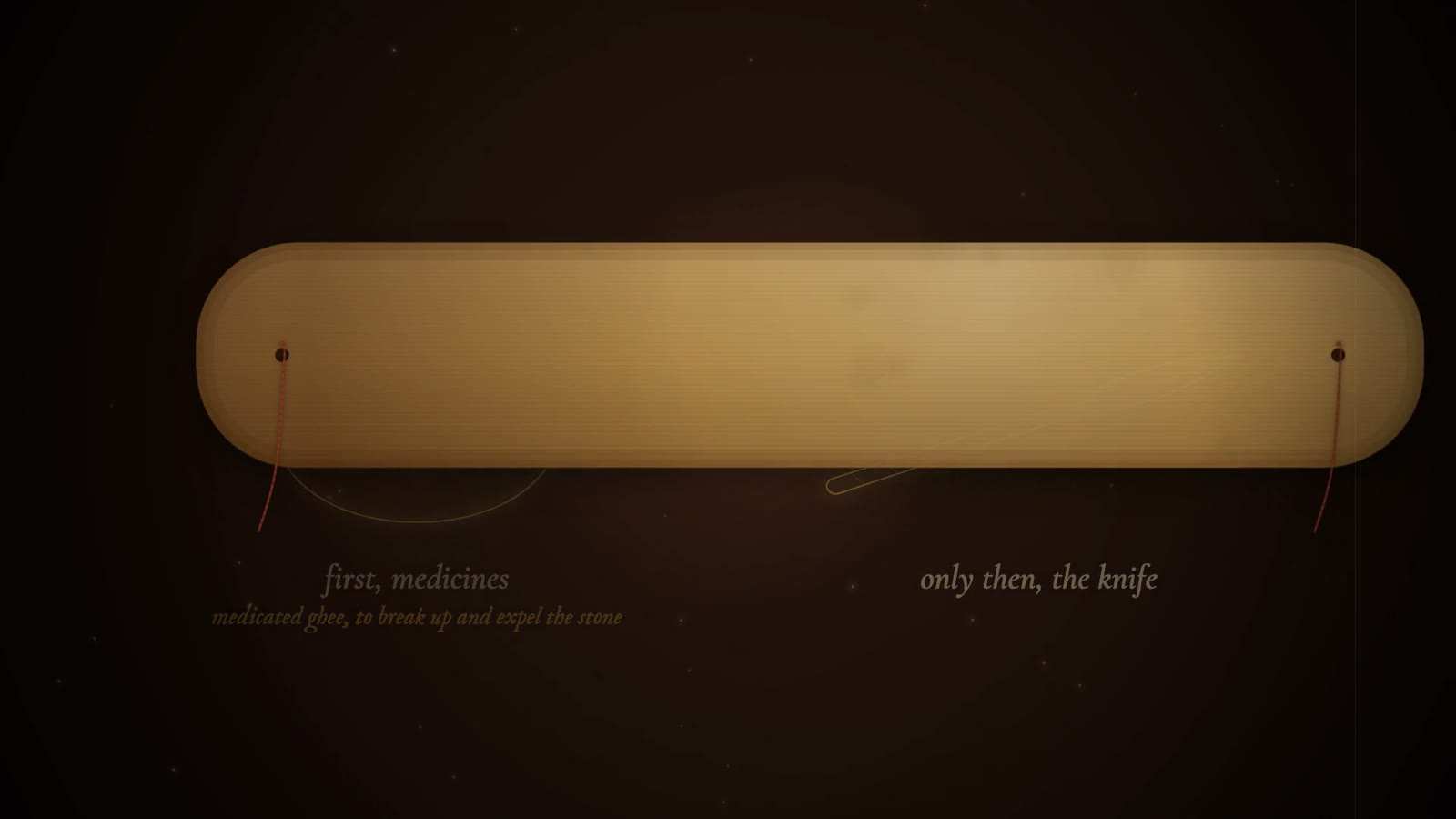
The chapter on stone sets out medicines before the operation: medicated clarified butter is said to break up and expel the stone.
Bhishagratna vol. II p. 386; the operation follows from p. 388. The film's 'only when they fail does the book consider the knife' is not in the passages quoted for the film (see gaps).
-
The text warns that death is almost certain without operation and that the result of operation is also uncertain, and it says that a skilled surgeon should operate only with the king's permission.
Bhishagratna vol. II p. 388. The passages read do not show the words that join the two sentences. A similar call to inform the king, because success is uncertain, appears on p. 460 for another dangerous operation.
-
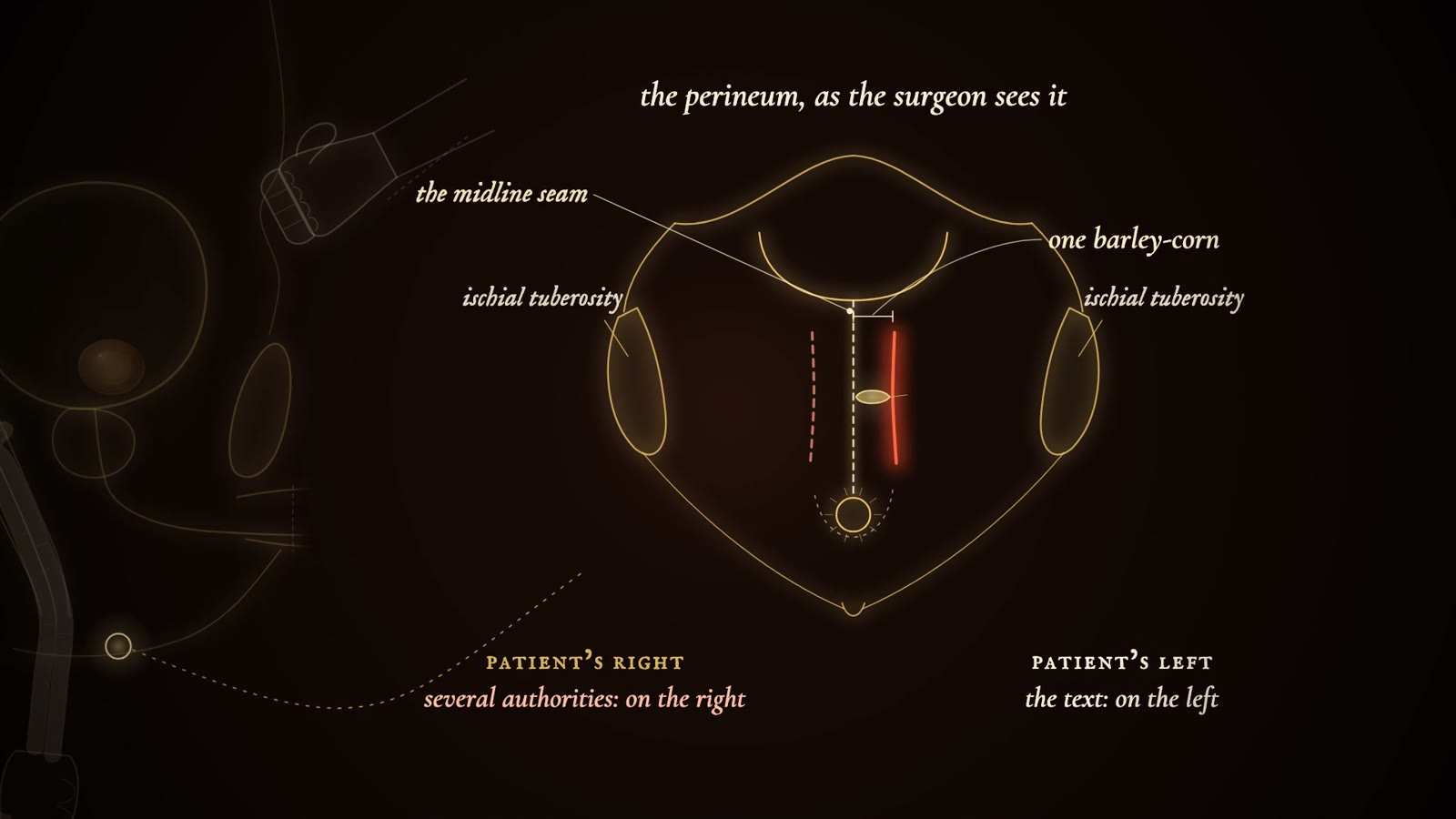
The second and third fingers of the surgeon's left hand, in the rectum, bring the stone between the rectum and the penis; a closed fist presses down the left side of the umbilical region so that the stone comes within reach; and the incision is made on the left of the perineal raphe, at the distance of a barley-corn.
Bhishagratna vol. II pp. 389 to 390. The film says the fist holds the stone there; the translation gives its purpose as bringing the stone within reach (see conflicts).
-
Bhishagratna's translation records that several authorities recommended making the opening on the right of the perineal raphe, for the convenience of the operation.
Bhishagratna vol. II p. 390. The screenplay's note places this sentence in the main text (verse 13); the research dossier left open whether it could be the translator's note (see conflicts).
-
After extraction the text prescribes a sitting bath in a cauldron (droni) of warm water, a treacle solution to clear the urinary passage, and honey and clarified butter for the wound.
Bhishagratna vol. II p. 391.
-
The passages of the text read for the film give no count of survivors; they say that without operation death is almost certain and that the result of operation is uncertain. probable
No mortality figures for ancient lithotomy are known from the sources read. The chapter was retrieved by full-text search, not read in full.
-
For Niruddha-prakasha, which Bhishagratna renders as constriction or stricture of the urethra, the text advises tubes of iron, wood or shellac, open at both ends, lubricated with clarified butter, passed gently and followed by thicker tubes every third day.
Bhishagratna vol. II p. 512. What the condition is, a stricture or a tight foreskin, is a separate entry.
-
Sources in the kit differ on the condition treated with the tubes: a stricture of the urethra or a tight foreskin. disputed
- Version 1
Bhishagratna renders Niruddha-prakasha as 'constriction or stricture of the urethra' (vol. II p. 512).
- Version 2
The screenplay's note cites p. 148 of the translation for a description of the condition as a tight foreskin (phimosis); that page was not read for the research dossier.
No scholarly discussion of the term is in the kit, so the film's 'scholars read it both ways' is not shown here (see gaps).
- Version 1
-
The method is graduated dilation: tubes of increasing thickness passed at intervals of three days. probable
Bhishagratna vol. II p. 512. The research dossier calls the method a direct ancestor of the bougie; no source in the kit makes that link, and the film's 'still in use today' is not sourced (see gaps).
Myths corrected
-
Traditional, not established. Sushruta lived and wrote around 600 BC.
-
Misread. Sushruta performed 300 operations with 120 instruments.
-
Overstated. Sushruta invented lithotomy.
-
No data. Ancient perineal lithotomy killed a known percentage of patients.