Chapter IV
The Flask
Byzantium, Kairouan, Salerno, Córdoba, London, 600 to 1650
Watch this chapter 14:44 in the filmRuns 4 min 25 s
Summary
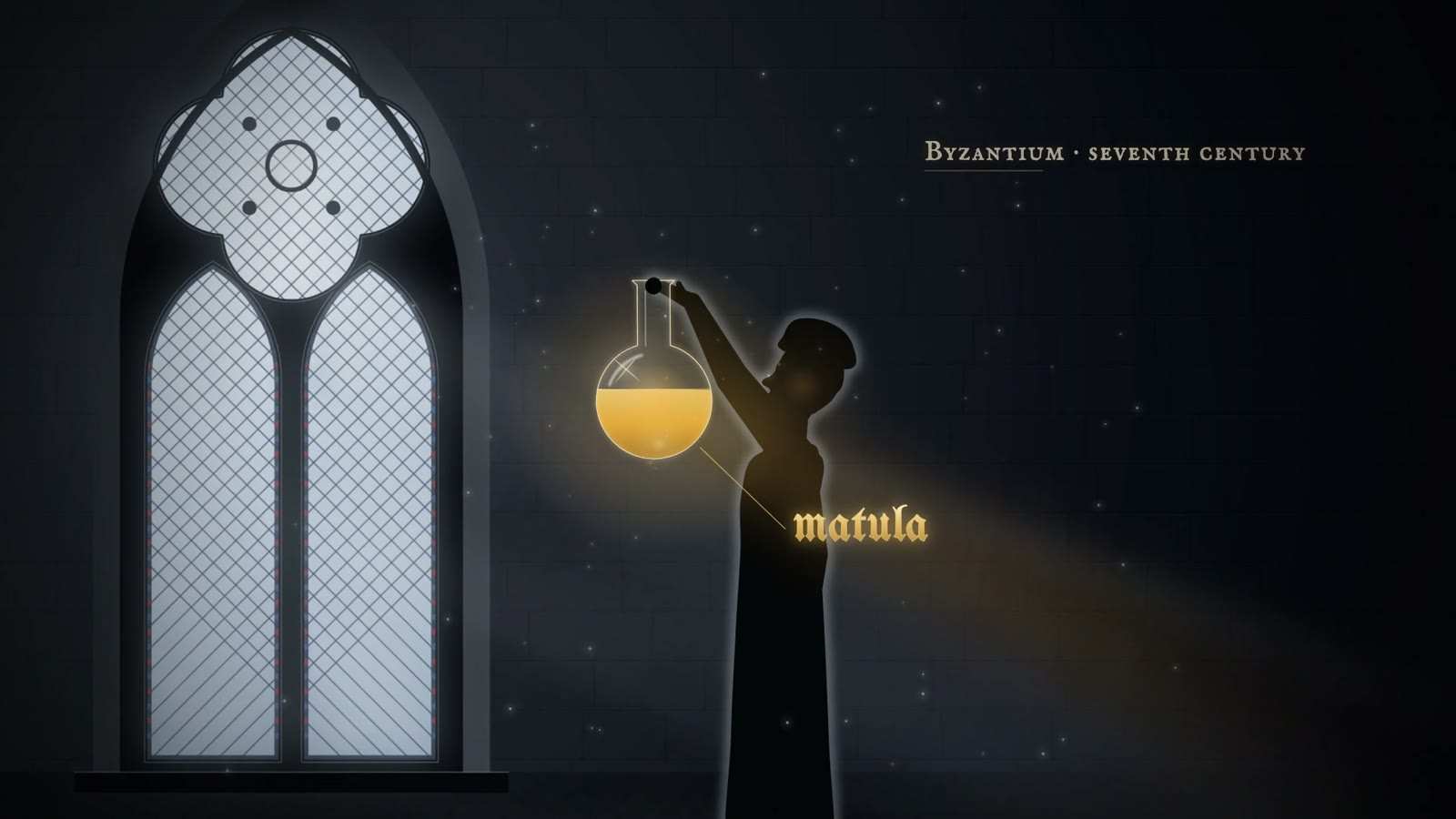
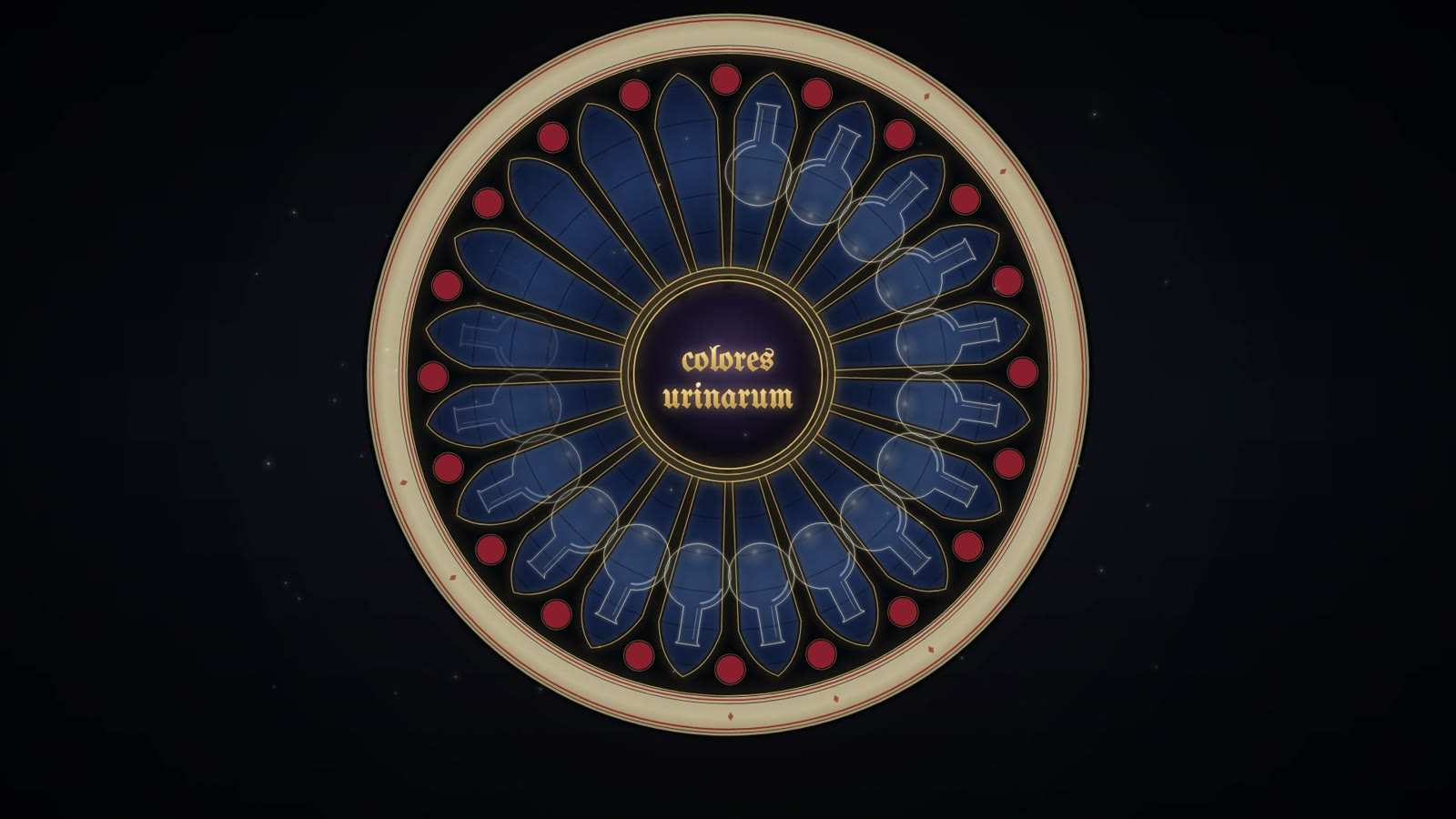
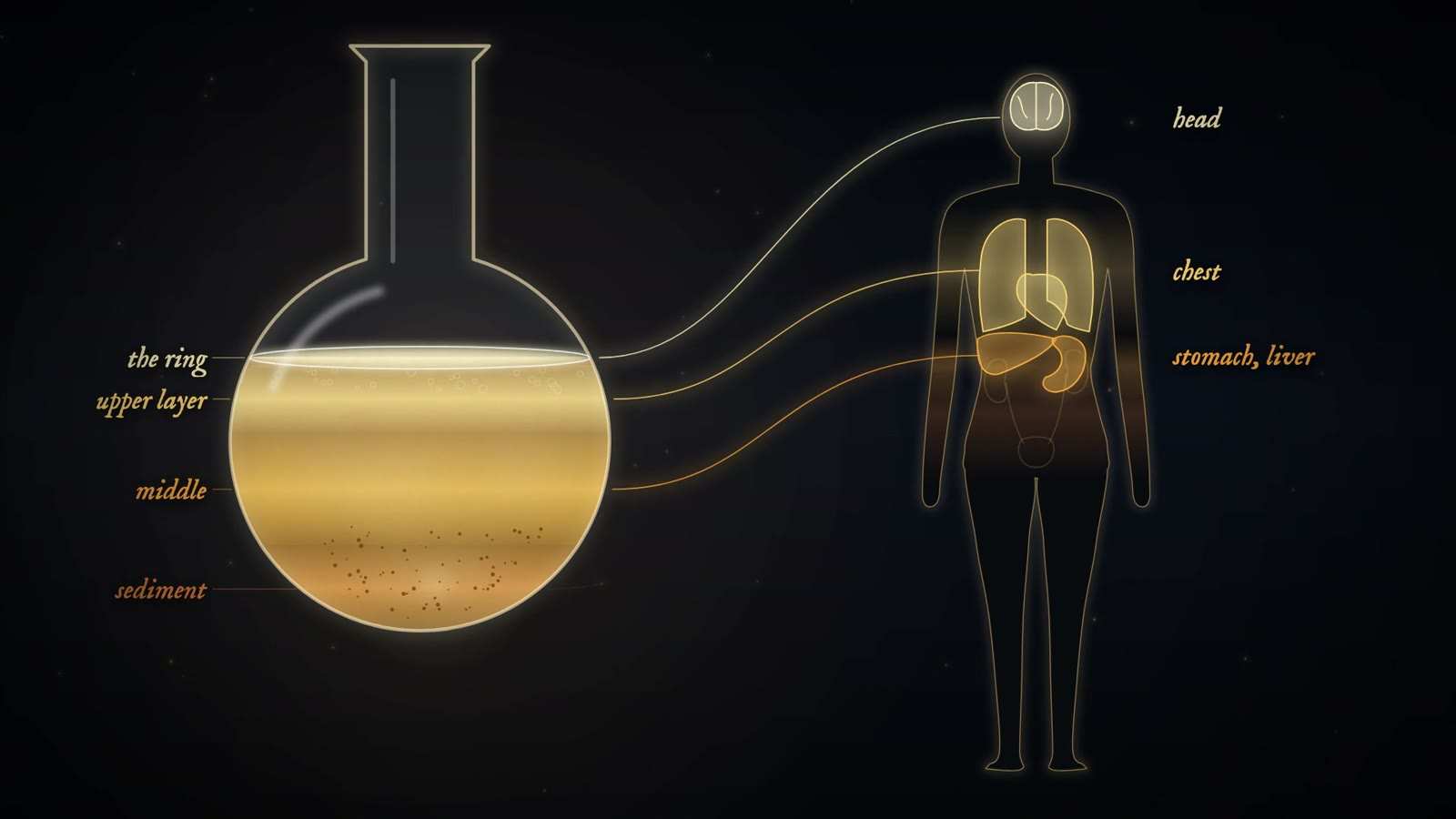
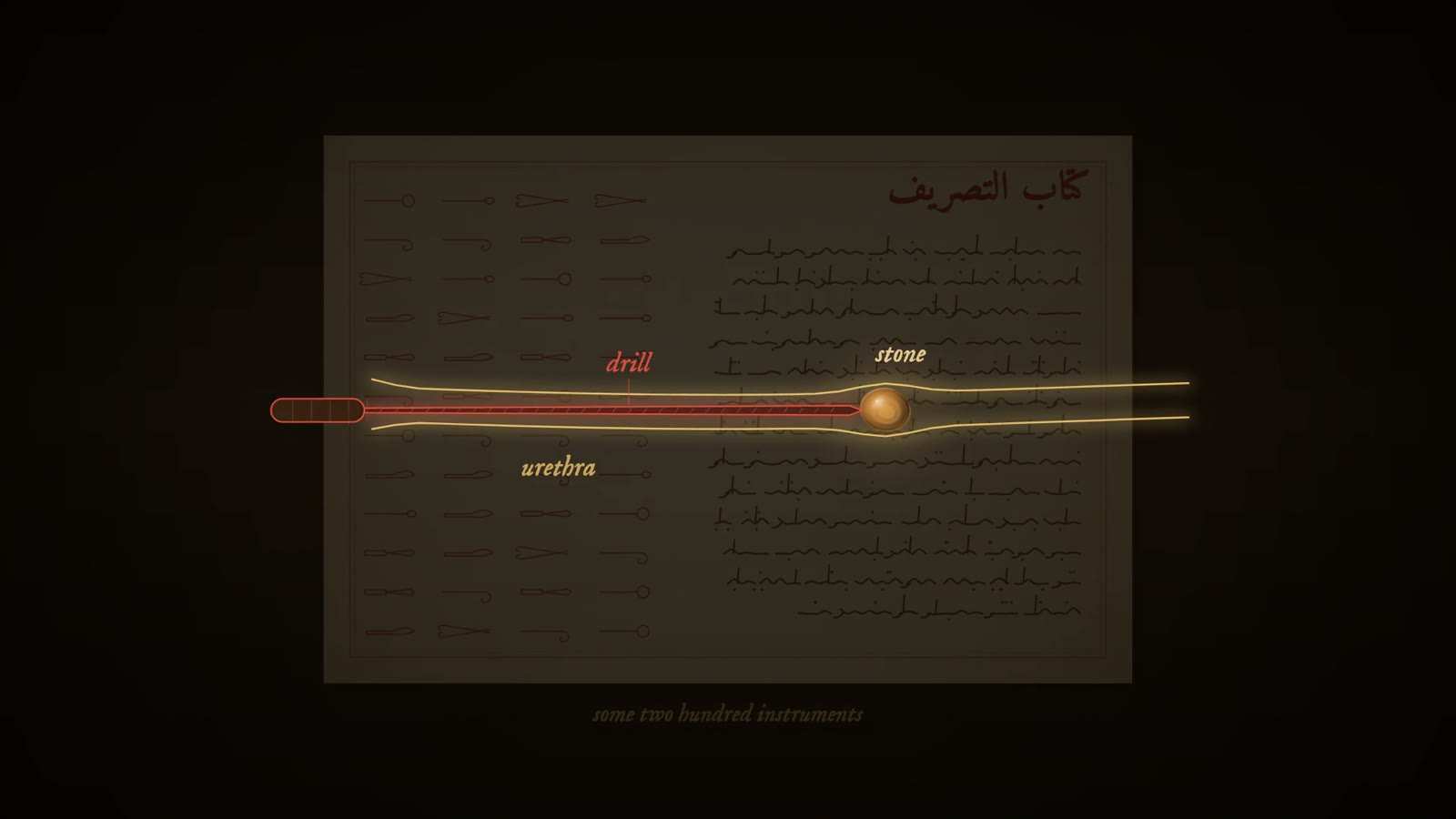
Chapter IV follows urine as the main object of learned diagnosis from late antiquity to the seventeenth century. The physician's emblem was the matula, a clear, round-bottomed glass flask shaped like a bladder, held to the light so that colour, consistency and sediment could be judged. In the seventh century the Byzantine author Theophilus wrote a treatise on urine and defined it as colamentum sanguinis, the filtrate of the blood, a phrase the film brings back at the end of Chapter V. Isaac Israeli at Qayrawan in the early tenth century, the Salernitan tradition and Gilles de Corbeil at Paris turned the reading into a taught discipline. Charts set out about twenty colours in a wheel, from clear to black, and the column of liquid was mapped onto the body from head to pelvis. Often the physician never saw the patient; a messenger brought the flask. In Córdoba, around the year 1000, al-Zahrawi illustrated some two hundred instruments in al-Tasrif, among them a drill for stones lodged in the urethra, a silver catheter and a bladder syringe. Doubt ran alongside the practice. Isaac warned against prophecy without the patient, Shakespeare made it a joke, and in 1637 Thomas Brian's The Pisse-Prophet denied that any disease could be known from urine alone, and admitted that he had faked readings himself. Uroscopy held learned medicine for about a thousand years, and patients asked for it for two centuries more.
Watch, shot by shot
-

-
-
-
-
-

-
In their words
“Sirrah, you giant, what says the doctor to my water?”
Spoken by Falstaff to his Page. The film's text matches the Folger edition.
“He said, sir, the water itself was a good healthy water; but, for the party that owed it, he might have more diseases than he knew for.”
Spoken by the Page. The Folger text has a comma after 'a good healthy water' where the film has a semicolon; see conflicts.
“There is no certaine knowledge of any Disease to be gathered from the Urine alone.”
Original spelling kept. An excerpt from a longer sentence in the Preface; the film capitalises its first word. The research cites the Preface without naming the printing checked; the 1637 and 1679 scans are both listed.
“The Urine is an Harlot, or a Lyer.”
Brian gives the Latin first: '(Urina est meretrix, vel mendax) the Urine is an Harlot, or a Lyer'. The narration calls it borrowing a Latin tag. The wording was verified in the 1679 printing.
What the film says, and the evidence
Verified claims are shown plain. probable means one reliable source; disputed means the sources disagree, and both versions are shown. Unverified material is not published here.
-
The matula, a round glass flask shaped like a bladder, became the emblem of the physician; the doctor held it up to the light to read the urine.
SourcesClear, colourless glass and a rounded base let the reader judge colour and inspect the sediment. The sources call the matula the physician's symbol but give no span of time for it (see gaps).
-
In the seventh century the Byzantine author Theophilus wrote a treatise on urine, De urinis, and defined urine as the filtrate of the blood (colamentum sanguinis). probable
SourcesBoth sources place Theophilus in the seventh century (Wallis: 'highly likely'; the EAU History Office: the reign of Heraclius); the exact date is not known. The definition of urine as colamentum sanguinis is reported by one source (Wallis 2000). That his was the first text devoted solely to urine is probable, not verified, and the film does not claim it.
-
Writers on urine included Isaac Israeli, who worked at Qayrawan (Kairouan), and Gilles de Corbeil, who studied and taught in the Salernitan tradition, was royal physician at Paris, and wrote a verse De urinis as a memory aid for students.
SourcesThese are the two authors the sources tie to the places the narration names. No source read describes uroscopy across the Mediterranean world as a whole.
-
Urine charts set out about twenty colours in a wheel, running from white or crystal clear to black.
Sources- Harvey, Troubled Waters (Public Domain Review) Secondary
- Royal College of Physicians Library: The urine wheel Museum or society
- Wikipedia (German): Harnschau Secondary
Charts show 20 or 21 flasks depending on source and edition, so 'about twenty' is the safe figure. The run of intermediate colours (pale yellow, camel-hair beige, wine red, liver colour, deep green) comes from one source, the German Wikipedia summary of Zglinicki 1982. The colour 'livid' in the narration is not named in the sources read (see gaps).
-
On one urine wheel, the late 14th-century Bodleian MS Savile 39, three very dark flasks signify death. probable
SourcesFour reddish-gold flasks on the same wheel signify good digestion. One source. No source read states that black meant death as a rule (see gaps).
-
The flask was read as a map of the body: the ring at the surface for the head, the upper layer for the chest, the middle for the stomach and liver, and the sediment for the kidneys, bladder and genitals. probable
Sources- Wikipedia (German): Harnschau Secondary
- Harvey, Troubled Waters (Public Domain Review) Secondary
The zone-by-zone mapping comes from one source (Zglinicki 1982, via the German Wikipedia article). A second account (Harvey) agrees only that the top layer, the middle and the sediment were each read for different signs, and that a large top layer could signify pain in the head.
-
In parts of Europe the physician often never saw the patient: a messenger brought the urine to him.
SourcesEspecially common in German-speaking lands. The basket shown in the film comes from period imagery and is not documented in the sources read (see gaps).
-
al-Zahrawi (Abulcasis, or Albucasis), who was born near Córdoba and died about 1013, illustrated about two hundred surgical instruments in the final, surgical part of his encyclopaedia, al-Tasrif. probable
Sourcesal-Tasrif has thirty parts; the last deals with surgery: cautery, incision and bone-setting. His birthplace and death are given by all three sources (birth as 930 or 936); the count of about two hundred instruments by one (Hektoen).
-
Among the instruments of al-Tasrif is a drill for a stone stuck in the urethra.
SourcesOne source (Hektoen) describes it as fine-pointed and turned gently against the stone until it was pierced, the fragments then being squeezed out with the urine; another (IEEE Pulse) gives a steel shaft with a triangular point, set in a wooden handle.
-
al-Tasrif also describes a silver catheter about one and a half spans long. probable
SourcesOne modern source: straight, narrow and smooth, about one and a half spans (about 33 cm) long, with a small funnel at the outer end, lubricated before use and used to wash the bladder.
-
It also describes a syringe for the bladder whose cannula has three holes at the tip. probable
SourcesThat al-Zahrawi used a syringe on the bladder is verified; the three holes and the materials (silver or ivory) come from one source.
-
al-Tasrif was translated into Latin by Gerard of Cremona in the 12th century. probable
SourcesOne source gives 1150.
-
Isaac Israeli, physician at Qayrawan to the first Fatimid caliph, wrote a Book of Urine (Kitab al-Bawl); Constantine the African put it into Latin in the late 11th century.
Sources- Wikipedia: Isaac Israeli ben Solomon Secondary
- Posen Library: Isaac Israeli, Book of Urine Secondary
- Utrecht University Special Collections: De urinis by Isaac Israeli Museum or society
The sources give no year for the book. Isaac's death is given variously between about 932 and 950; the caliph he served, Ubayd Allah al-Mahdi, reigned 910 to 934. German (1280) and Catalan (1392) versions followed.
-
Isaac warned against fools who based prophecies on urine without seeing the patient. probable
SourcesKnown through a modern translation quoted by one source; the wording is a paraphrase.
-
In Henry IV Part 2, Falstaff asks his Page what the doctor says to his water, and the Page reports that the water was healthy but its owner might have more diseases than he knew.
SourcesMacbeth (5.3) and Twelfth Night (3.4) also mention casting or carrying the water (Folger texts).
-
In 1637 Thomas Brian published The Pisse-Prophet, or Certaine Pisse-Pot Lectures, which set out the 'fallacies, deceit, and jugling' of those who claimed to know diseases by the urine.
SourcesThe imprint is London and the author is styled 'Tho. Brian, M.P.'; the book was reissued in 1655 and 1679. The narration's 'English physician' is not stated in the sources read (see gaps).
-
Brian gave the Latin 'Urina est meretrix, vel mendax' and rendered it 'the Urine is an Harlot, or a Lyer'.
SourcesChecked in the 1679 printing. That the Latin was a saying already in use, as the narration's 'borrowing a Latin tag' implies, is not stated in the sources read (see gaps).
-
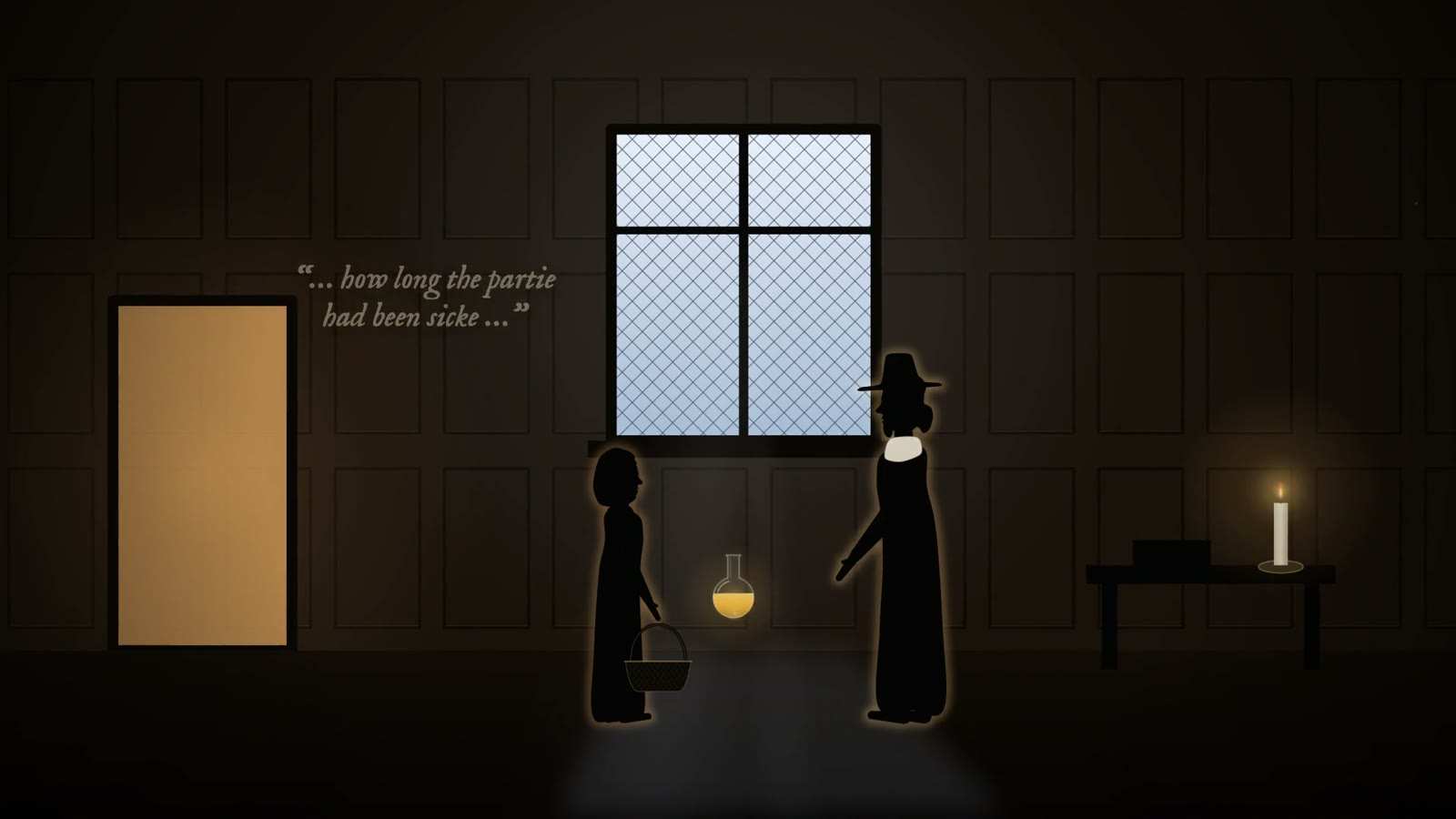
Brian admitted that he had played the pisse-prophet himself: a counsellor's wife called him 'the cunningst Doctor in all the Town' because he had told her by her water that she was with child. In the book he describes getting information by asking the messenger how long the patient had been sick.
SourcesThe counsellor's wife passage was checked in the 1679 printing; the 1637 preface says he wrote the book to make amends to the women he had beguiled. Descriptions of his staged 'reading' of the glass come from one secondary source.
-
Uroscopy's prestige peaked between the 13th and 16th centuries; patients still favoured it until the 19th century, when scientific analysis of urine displaced it. probable
Sources- JSTOR Daily: Early doctors diagnosed disease by looking at urine Secondary
- EAU History Office: Uroscopy Museum or society
- Wikipedia (German): Harnschau Secondary
The peak rests on one source (JSTOR Daily, summarising Stolberg 2007); the patients' preference until the 19th century on the EAU History Office, and the displacement from the early 19th century on the German Wikipedia. The narration's 'about a thousand years' and 'two centuries more' are the research dossier's reckoning from these dates, not a source statement (see gaps).
Myths corrected
-
Unsupported. Gilles de Corbeil introduced the matula.
-
Overstated. Theophilus invented the test for albumin in urine.
-
Oversimplified. Urine charts always showed twenty colours, and colour was the whole of uroscopy.
-
Unsupported as priority claims. Albucasis invented lithotripsy and was the first to remove a bladder stone with forceps.
-
False. Thomas Brian's The Pisse-Prophet was published in Colchester.
-
Unsupported. A Jerusalem Code of 1090 fined physicians who failed to examine the urine.
-
Unsupported as stated. Thomas Linacre, founder of the Royal College of Physicians, passed a statute forbidding diagnosis from urine alone, sometimes dated 1555.
-
Apocryphal. A famous physician, asked to judge a patient's urine, told the messenger to bring the patient's shoe instead.
-
Unverified. The first English book on uroscopy was printed by Wynkyn de Worde in 1512.
-
Unsupported. Uroscopy began some six thousand years ago in Babylon.