Chapter VIII
Light
Frankfurt to Tuttlingen, 1806 to 1967
Watch this chapter 38:34 in the filmRuns 9 min 40 s
Summary
Chapter VIII follows the effort to see inside the living urinary tract, from a candle in Frankfurt to the rod-lens telescope. Philipp Bozzini's Lichtleiter, shown from 1804, kept the path of the light apart from the path of the eye. Sent to Vienna, it was praised and improved at the army's medical academy, the Josephinum, and dismissed by the University faculty; the exact words of that dismissal are uncertain, and the famous 'magic lantern' phrase first appears in a biography of 1876. Bozzini died of typhus in 1809, aged 35. In Paris, Ségalas showed a lit urethral speculum in 1826, and Desormeaux, using the side light and inclined mirror that Fresnel had suggested to Ségalas, showed and named the endoscope in 1853. Nitze and the Viennese maker Leiter put a water-cooled platinum filament at the tip of a lens telescope, demonstrated it on a living patient on 9 May 1879, and then fell out over the credit. Incandescent bulbs reached cystoscopes in 1886-1887. Albarrán's lever let the urologist steer a catheter into a ureter, and Hugh Young looked up a dilated ureter in 1912. Röntgen's rays gave a second kind of sight, which Henry Morris feared might deter surgical exploration. Retrograde pyelography (1906) and Moses Swick's intravenous urography (1929) followed, the second with a long dispute over credit. Harold Hopkins's fibre bundle (1954) and rod lens, built by Karl Storz from 1967, moved the light back outside the body.
Watch, shot by shot
-
-
-
-
-
-
-
-
-
-
In their words
“The usefulness of the light conductor is so general that it must have, directly or indirectly, the most significant influence on every part of medicine.”
The film's own translation of the German as quoted by Hock: 'Der Nutzen des Lichtleiters ist so allgemein, daß er auf jeden Theil der Heilkunde mittelbar oder unmittelbar den bedeutendsten Einfluß haben muß.' The dossier's own rendering places 'directly or indirectly' later in the sentence; the meaning is the same.
- P. Bozzini, German original as quoted by Hock, Frankfurter Personenlexikon; the original publication and its year were not identified by the dossier Primary
- Hock, Frankfurter Personenlexikon (2014): Bozzini, Philipp Secondary
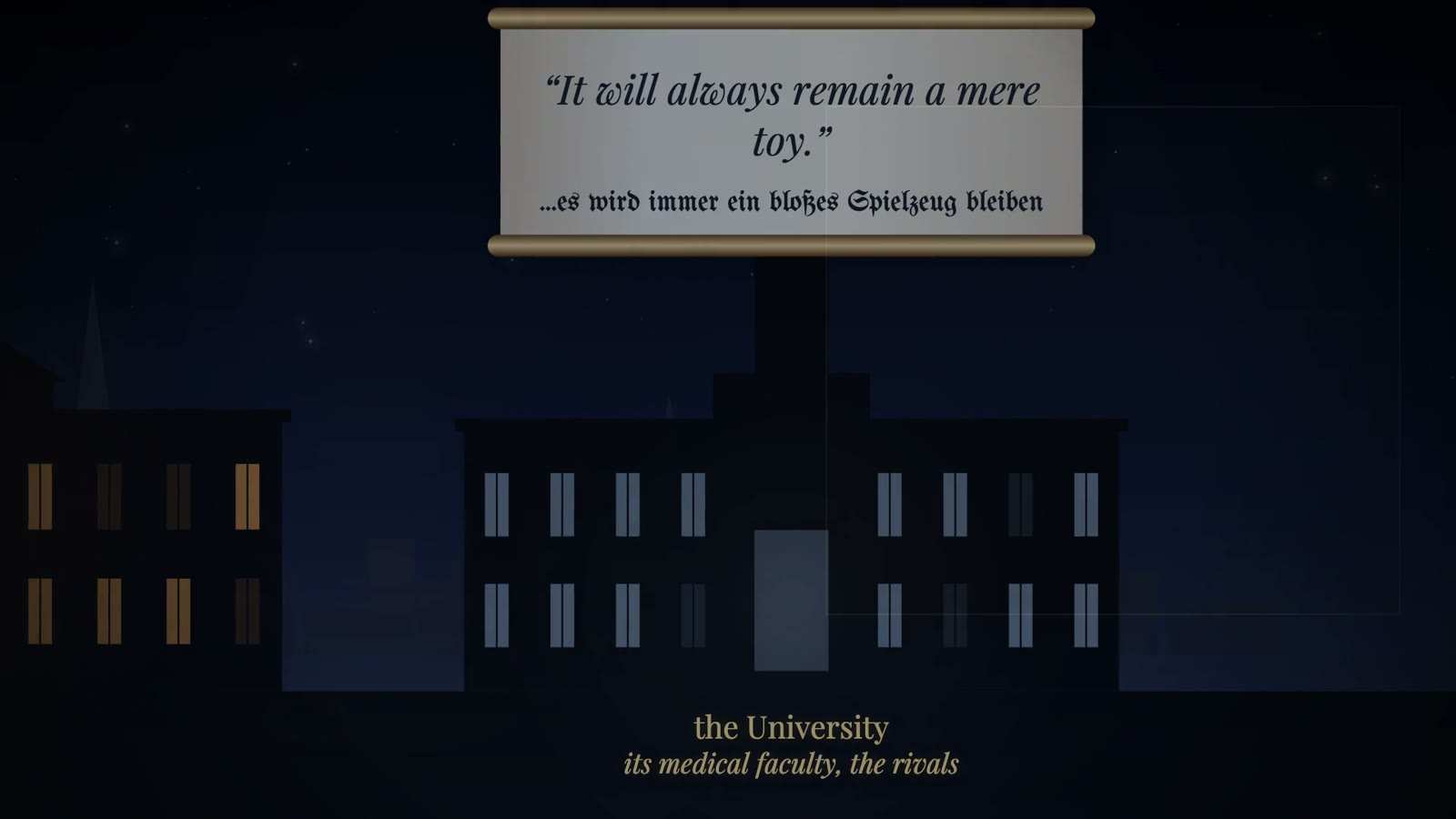
“It will always remain a mere toy.”
The film's own translation of 'es wird immer ein bloßes Spielzeug bleiben'. Hock (2014) gives a close variant, 'bloßes Spielwerk' ('a mere plaything'). The primary document has not been seen. The film voices the line as a single professor; the sources attribute it to the faculty, not to any named individual. See the debate on the Vienna verdict and conflicts.
“When, in its infancy, it was shown to some of my colleagues, one of whom remarked: We can see well with your instrument; but what is the use of seeing?”
Hunt's text sets the colleague's words in quotation marks and reads 'with your instrument, but what is the use of seeing?'; the film uses a semicolon. Desormeaux continues that he could answer only with generalities and thought it best to keep quiet.
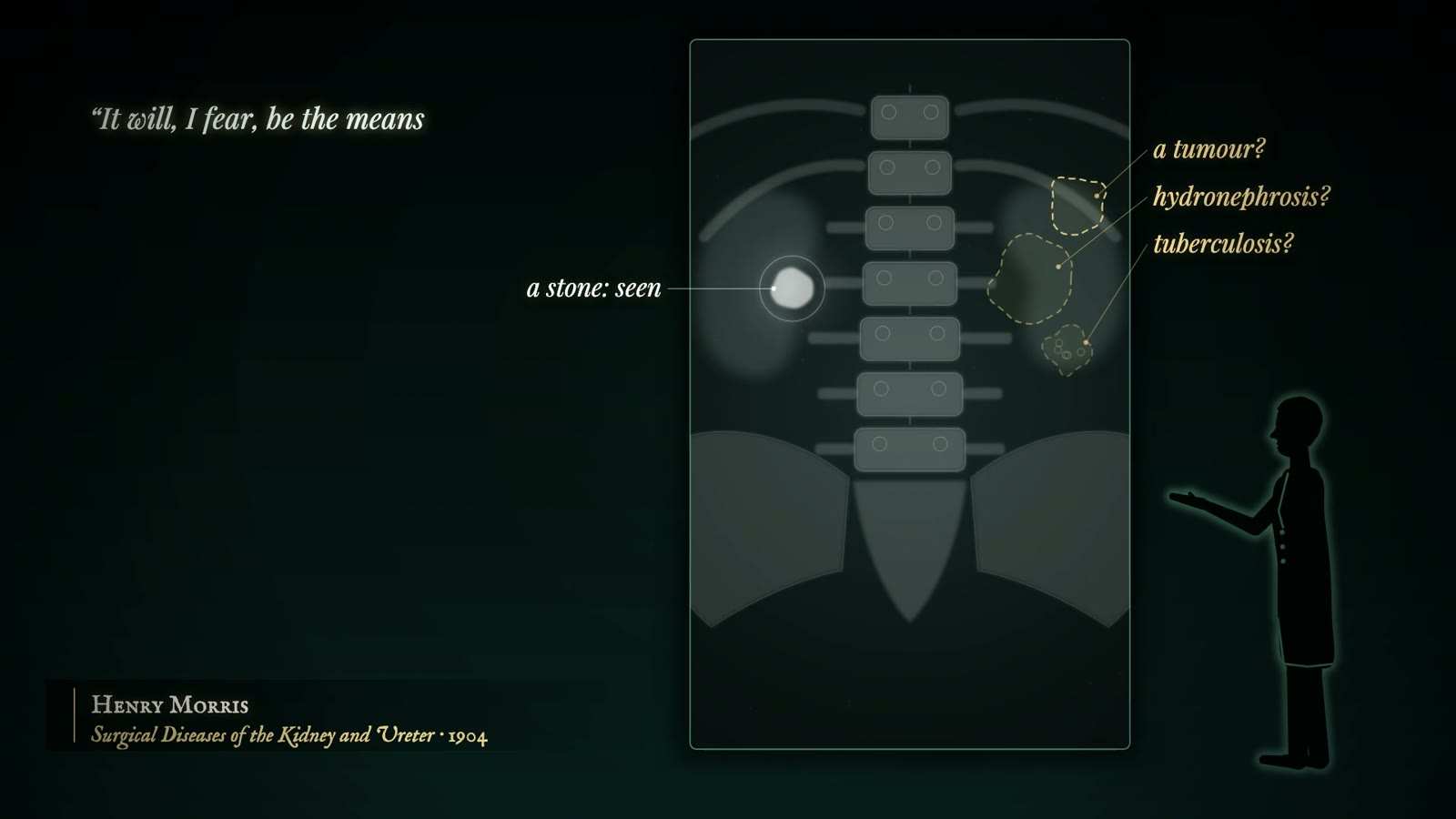
“It will, I fear, be the means of putting back renal surgery, by deterring many patients from submitting to surgical explorations who can be cured by no other treatment than an operation.”
As quoted in Urology News; the dossier did not see the original. The screenplay note cites vol. 2, p. 104. The Urology News wording ends 'no other method than an operation' where the film says 'no other treatment than an operation'; see conflicts.
- H. Morris, Surgical Diseases of the Kidney and Ureter (1904), as quoted in Urology News; the original page was not seen by the dossier Primary
- Urology News: Early British pioneers of urological imaging Secondary
What the film says, and the evidence
Verified claims are shown plain. probable means one reliable source; disputed means the sources disagree, and both versions are shown. Unverified material is not published here.
-
Bladder stone was diagnosed by sounding, a metal sound clicking against the stone, from antiquity until X-rays and cystoscopy, after which the practice soon lapsed. probable
SourcesSingle secondary source (Urology News). The film's wider point, that disease inside the living body was otherwise inferred from symptoms and the urine, is the dossier's own summary without a source and is logged in gaps.
-
Philipp Bozzini, a physician in Frankfurt, first showed his Lichtleiter publicly there in 1804 and described it in 1806 in the Journal der practischen Arzneykunde und Wundarzneykunst.
SourcesThe 1806 article is 'Lichtleiter, eine Erfindung zur Anschauung innerer Theile und Krankheiten', vol. 24, pp. 107-124, known from Wallace's reference list and a 2023 Springer citation. A monograph followed in Weimar in 1807.
-
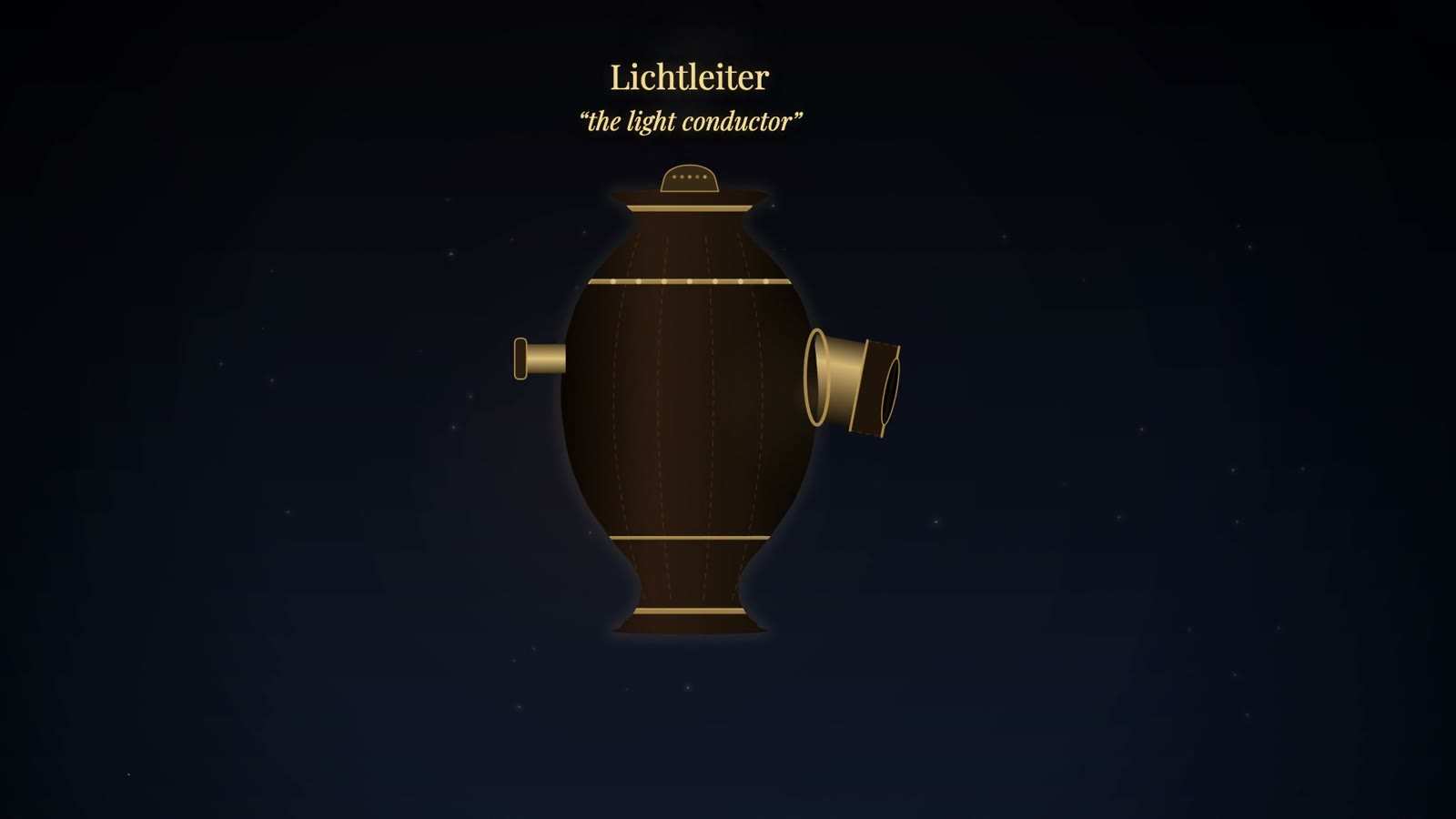
The Lichtleiter was a vase-shaped housing about 35 cm tall. Inside it a wax candle stood before a concave mirror, which threw the light forward into the tube.
Sources- EAU History Office: Bozzini and the Lichtleiter Museum or society
- Wallace 1973, New lamps for old (RSM presidential address; BAUS archive) Secondary
- Wikipedia (de): Philipp Bozzini Secondary
- Endourology Society history article: Philipp Bozzini, the father of endoscopy Museum or society
- Medical University of Vienna alumni leaflet, December 2008 (archived) Museum or society
Size: EAU, the Endourology Society and the MedUni leaflet; candle and mirror: EAU, Wallace and the German Wikipedia. The covering material is disputed (leather over lead, paper and leather over sheet metal, or sharkskin over silver); the film draws a leather-covered vase but the narration names no material.
-
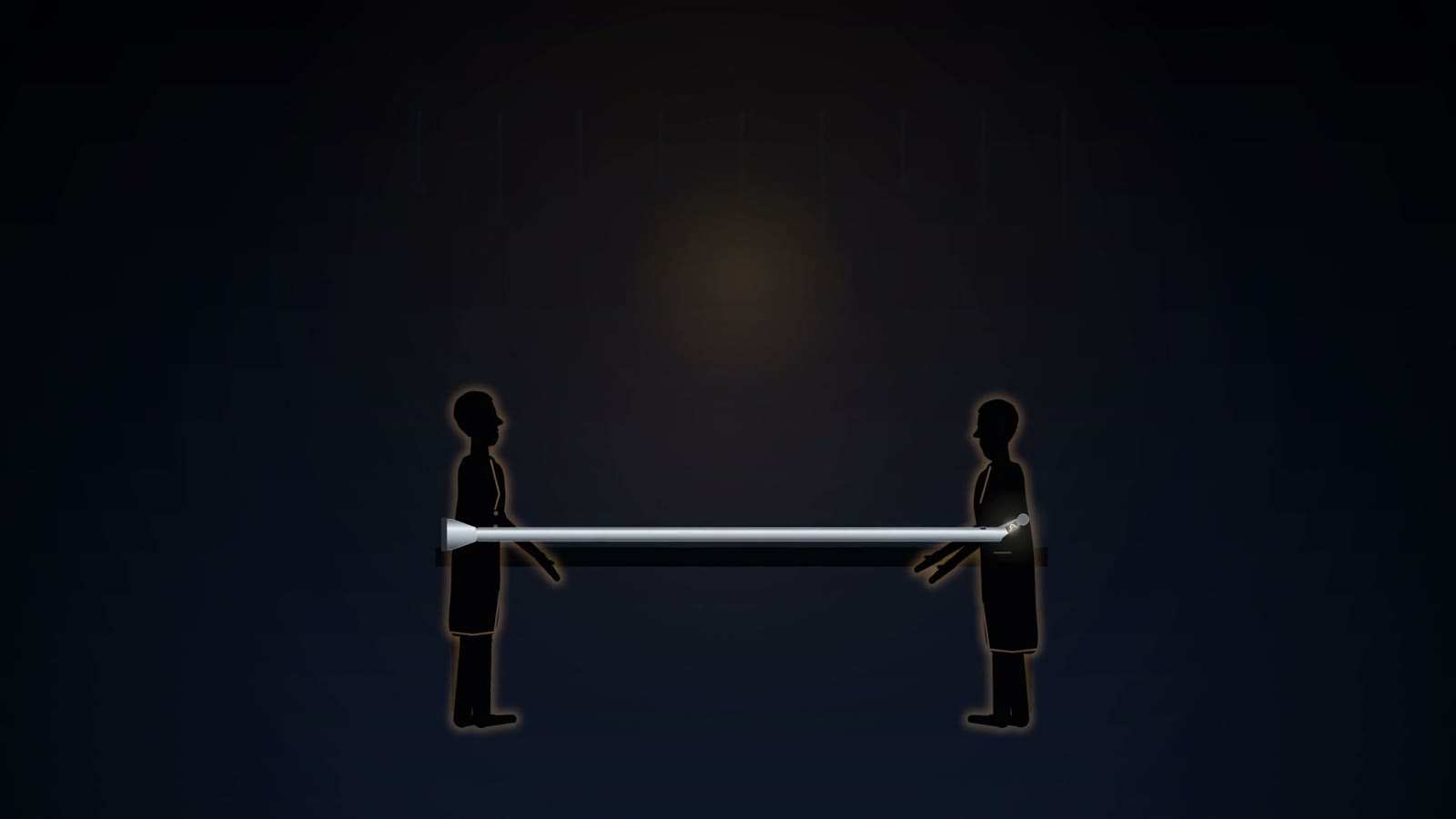
The candle was held on springs so that the flame kept its place as it burned down. Light went down one channel and the examiner looked back along a separate one, so that the glare of the flame did not wash out the view. probable
Sources- EAU History Office: Bozzini and the Lichtleiter Museum or society
Rests on the EAU account, which draws on Bozzini's 1806 description of a separate 'reflecting tube'. In the Frankfurt model the two tubes lie side by side, so the eyepiece sits off centre.
-
Bozzini did not take the instrument to Vienna himself: he could not afford the journey and sent it instead. probable
Sources- Medical University of Vienna alumni leaflet, December 2008 (archived) Museum or society
Single source (the 2008 Medical University of Vienna leaflet). That the Emperor, through Archduke Karl, had an instrument bought and examined is verified (Hock; the Josephinum exhibition text), as is its arrival in Vienna in November 1806 (EAU).
-
At the Josephinum, the military surgical academy, the instrument was tried on a cadaver on 9 December 1806 and judged favourably; the minute, as the 2008 Vienna leaflet quotes it, found it to meet every expectation.
Sources- Medical University of Vienna alumni leaflet, December 2008 (archived) Museum or society
- EAU History Office: Ilg's Vienna model Museum or society
- Endourology Society history article: Philipp Bozzini, the father of endoscopy Museum or society
The minute's phrase is 'aller Erwartung vollkommen zusagend befunden' (MedUni leaflet). The session report quoted by EAU refers to the experiments of 9 December 1806 as wholly to the inventor's credit, and the Endourology Society article reports cadaver tests to the same effect. The academy praised the instrument as an ingenious invention.
-
Within two months the Josephinum's prosector, Johann Georg Ilg, built an improved Viennese model, judged superior to the original at an Academy session on 17 January 1807. probable
Sources- EAU History Office: Ilg's Vienna model Museum or society
- Medical University of Vienna alumni leaflet, December 2008 (archived) Museum or society
The film does not name Ilg. His report, dated 1 October 1807, was found in a Viennese archive by Peter Paul Figdor in 2001; no original instrument survives.
-
The University of Vienna medical faculty, the academy's institutional rival, judged the instrument negatively.
Sources- Hock, Frankfurter Personenlexikon (2014): Bozzini, Philipp Secondary
- Medical University of Vienna alumni leaflet, December 2008 (archived) Museum or society
- Wikipedia (de): Philipp Bozzini Secondary
- Endourology Society history article: Philipp Bozzini, the father of endoscopy Museum or society
Bozzini published a reply on 28 March 1807. Who led the University testing, and why, rests on single secondary sources; see the debate on the Vienna verdict.
-
The film quotes the faculty's verdict as 'It will always remain a mere toy.' The sources give the rejection in three different wordings. disputed
- Version 1
The 2008 Medical University of Vienna leaflet gives 'es wird immer ein bloßes Spielzeug bleiben' ('it will always remain a mere toy') as the official assessment of the faculty.
Sources- Medical University of Vienna alumni leaflet, December 2008 (archived) Museum or society
- Version 2
Hock (2014) gives the verdict as 'bloßes Spielwerk' ('a mere plaything') and adds that intrigue against Bozzini probably played a part.
Sources - Version 3
Stricker's entry in the Allgemeine Deutsche Biographie (1876) says the faculty called the instrument 'laterna magica in corpore humano' ('a magic lantern in the human body'); it cites no document.
No primary document behind any of the wordings has been seen (dossier §11). The dossier prefers 'a mere toy' or 'plaything' to the 1876 phrase; the film quotes 'a mere toy' in its own translation.
- Version 1
-
The 'magic lantern in the human body' phrase is first found, in the sources checked, in a biography written long after Bozzini's death: Wilhelm Stricker's entry in the Allgemeine Deutsche Biographie of 1876, which attributes it to the Vienna medical faculty and cites no document.
SourcesThat the ADB contains the phrase is verified. As a literal quotation of the faculty it is disputed; Stricker also says the Josephinum rejected the instrument, which archival work contradicts.
-
During a typhus epidemic in 1809 Bozzini is recorded as saving 42 patients; he then caught the disease and died in Frankfurt on 4 April 1809, aged 35.
Sources- Hock, Frankfurter Personenlexikon (2014): Bozzini, Philipp Secondary
- Endourology Society history article: Philipp Bozzini, the father of endoscopy Museum or society
- EAU History Office: Philipp Bozzini, biography Museum or society
- Stricker, Allgemeine Deutsche Biographie vol. 3 (1876): Bozzini, Philipp (Wikisource) Secondary
Born 25 May 1773. The ADB places his death in the night of 4 to 5 April. His widow died about six months later.
-
In 1826 Pierre Ségalas presented a candle-lit urethro-cystic speculum to the Académie des sciences in Paris. probable
Sources- EAU History Office: Ségalas's speculum Museum or society
- Wallace 1973, New lamps for old (RSM presidential address; BAUS archive) Secondary
The date, the Académie and the candles rest on the EAU History Office alone; Wallace (1973) confirms that Ségalas proposed an endoscope. Only three clinical cases were reported, 1826 to 1828 (probable).
-
Desormeaux wrote that he had learned from Ségalas that Fresnel, leaving Ségalas's presentation of his urethro-cystic speculum to the Academy of Sciences, told him to place the light at the side and reflect it along the axis of the instrument with an inclined mirror; Desormeaux added that this was the arrangement of his endoscope.
Primary: Desormeaux, tr. Hunt 1867. The advice is known only through Ségalas's recollection as Desormeaux reports it. The text names 'Fresnel' without a first name or a role.
-
Antonin Desormeaux showed his endoscope in 1853.
SourcesThe year is secure; the day is disputed. Desormeaux's own lectures and EAU give 29 November 1853; Wikipedia and Nezhat give 20 July 1853 (French Academy of Sciences). Desormeaux had deposited a sealed paper with the Académie impériale de médecine at the end of 1852.
-
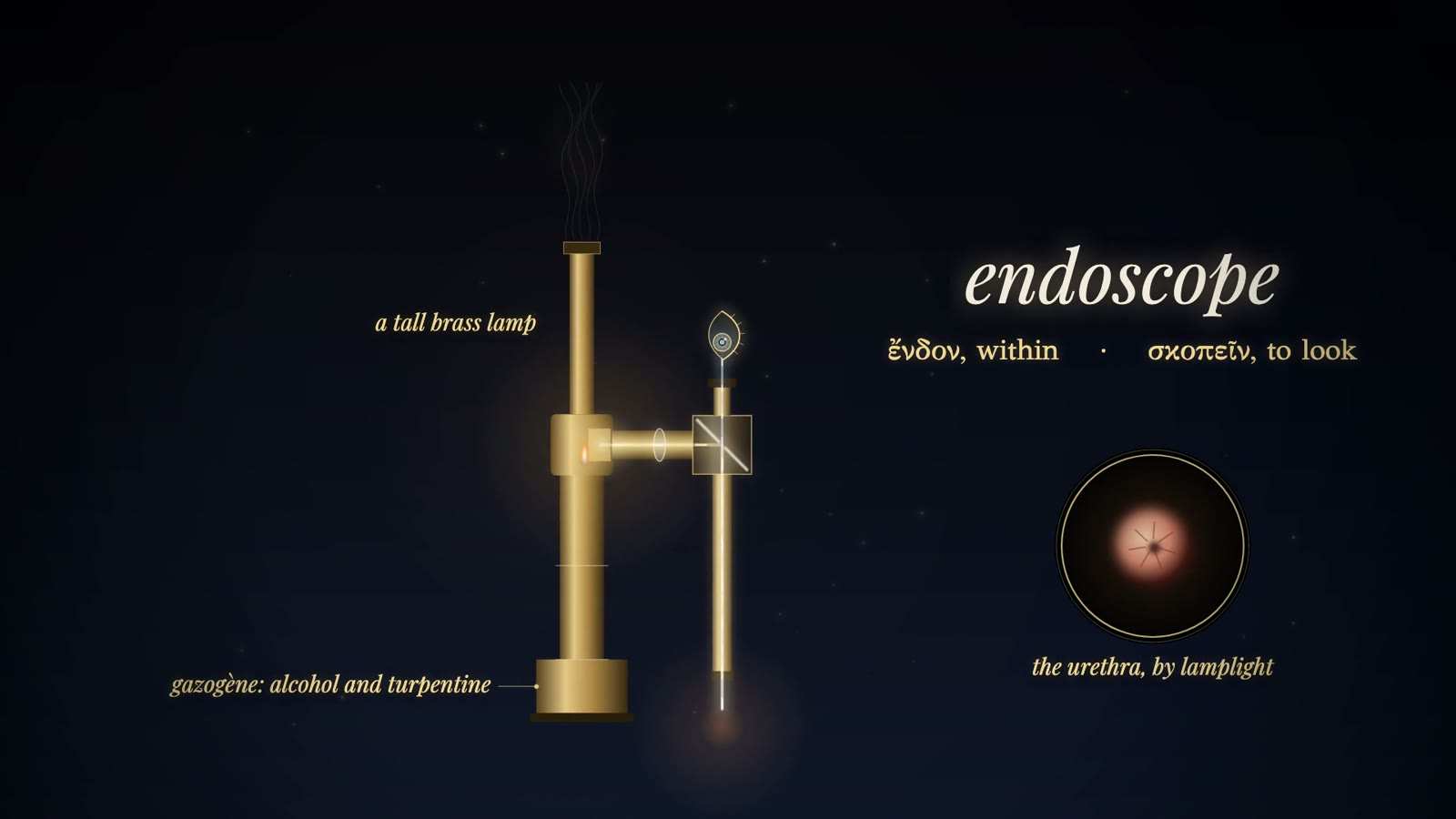
Desormeaux's lamp burned gazogene, a mixture of alcohol and turpentine. A lens concentrated the light onto a mirror set obliquely in front of the tube and pierced at its centre, and the examiner looked through the hole.
SourcesWallace adds paraffin to the fuel and Nezhat gives a 4:1 alcohol to turpentine ratio; neither detail is verified.
-
Desormeaux named his instrument l'endoscope and coined the word endoscopie. probable
Sources- EAU History Office: Desormeaux's endoscope Museum or society
Single cited source (EAU). The dossier also cites BAUS for this but names no page.
-
With the endoscope Desormeaux examined the urethra and bladder of living patients, recording urethritis, strictures, prostatic changes and bladder inflammation, and he cut strictures and cauterised granular lesions under vision.
Primary: Desormeaux, tr. Hunt 1867, which records these findings and operations.
-
When the instrument, in its infancy, was shown to some of his colleagues, one remarked that they could see well with it but asked what the use of seeing was. Desormeaux wrote that he could answer only with generalities and thought it best to keep quiet for the time being.
-
Desormeaux considered electric light and rejected it: too cumbersome to carry, needing an assistant, and likely to double the price of the instrument.
-
Maximilian Nitze, assistant at the Dresden City Hospital from 1876, is said to have seen a small inverted image of the church across the street while cleaning a dusty microscope eyepiece, and to have realised that a telescope could carry an image out of a hollow organ. probable
Sources- EAU History Office: Nitze's cystoscope Museum or society
- Neue Deutsche Biographie: Nitze, Maximilian Secondary
The anecdote rests on the EAU account, which quotes Nitze on 'a lucky break'; the film frames it as 'the story goes'. The church is named as the Matthäus Church.
-
Nitze's cystoscope put the light inside the bladder: a platinum wire made white-hot by current, cooled by a continuous flow of iced water, at the tip of a shaft containing a telescopic lens system.
Sources- Neue Deutsche Biographie: Nitze, Maximilian Secondary
- EAU History Office: Nitze's cystoscope Museum or society
- Wallace 1973, New lamps for old (RSM presidential address; BAUS archive) Secondary
Wallace notes the filament burnt out easily and needed elaborate water cooling.
-
The Nitze-Leiter cystoscope was demonstrated in Vienna on 9 May 1879.
Sources- EAU History Office: Nitze's cystoscope Museum or society
- Neue Deutsche Biographie: Nitze, Maximilian Secondary
The German Wikipedia article on Leiter gives November 1879. Who demonstrated it is disputed (light-21b); the film names no presenter.
-
Sources differ on who demonstrated the cystoscope on 9 May 1879. disputed
- Version 1
The surgeon Leopold von Dittel presented the Nitze-Leiter cystoscope, urethroscope and rectoscope on a living patient at a session of the k.k. Gesellschaft der Ärzte (EAU).
Sources- EAU History Office: Nitze's cystoscope Museum or society
- Version 2
Nitze demonstrated it: 'Am 9.5.1879 demonstrierte N.' (Neue Deutsche Biographie).
Sources
The film says only that it was shown on a living patient in Vienna. The dossier attributes Dittel's role to both sources, but the NDB words it quotes name Nitze; see conflicts.
- Version 1
-
Nitze and Leiter soon fell out over priority, and the instrument came to carry both their names.
Sources- EAU History Office: Nitze's cystoscope Museum or society
- Wallace 1973, New lamps for old (RSM presidential address; BAUS archive) Secondary
- Newell 1887, on the electric-light cystoscope (NLM Digital Collections) Primary
- EAU History Office: the Nitze-Leiter Collection Museum or society
That the dispute happened is verified; the personal details (Nitze demanding, Leiter ambitious) are probable.
-
Thomas Edison filed his US patent for an electric lamp, no. 223,898, on 4 November 1879.
SourcesGranted 27 January 1880. The film's 'six months after that demonstration' is the interval from the Vienna demonstration of 9 May 1879 (light-21).
-
By 1887 incandescent lamps had been fitted to cystoscopes in Vienna (Leiter, with Dittel) and in Berlin (Nitze, with the maker Hartwig).
SourcesLeiter's practical lamp cystoscope dates from late 1886; Dittel showed it to the Imperial Medical Society of Vienna in March 1887.
-
An American writer of 1887, Otis K. Newell of Boston, wrote that with the new instrument a growth in the bladder could be seen as plainly as a section under the microscope.
Newell's words are 'the growth could be seen as plainly as a section under the microscope'; the film says 'a tumour of the bladder'.
-
Joaquín Albarrán fitted a small deflecting lever, the 'levier d'Albarran', at the tip of the cystoscope to steer a ureteral catheter precisely into the ureteric orifice. probable
Sources- Wikipedia (fr): Joaquín Albarrán Secondary
No source dates the lever. The film's 'around 1897' is inferred from his manuscript 'Cystoscopie, travaux personnels, 1897', which the French Wikipedia lists (dossier §4, §11). Casper's uretero-cystoscope of 1895 came before it. He modified Casper's and Nitze's instruments and was the first in France to catheterise the ureter.
-
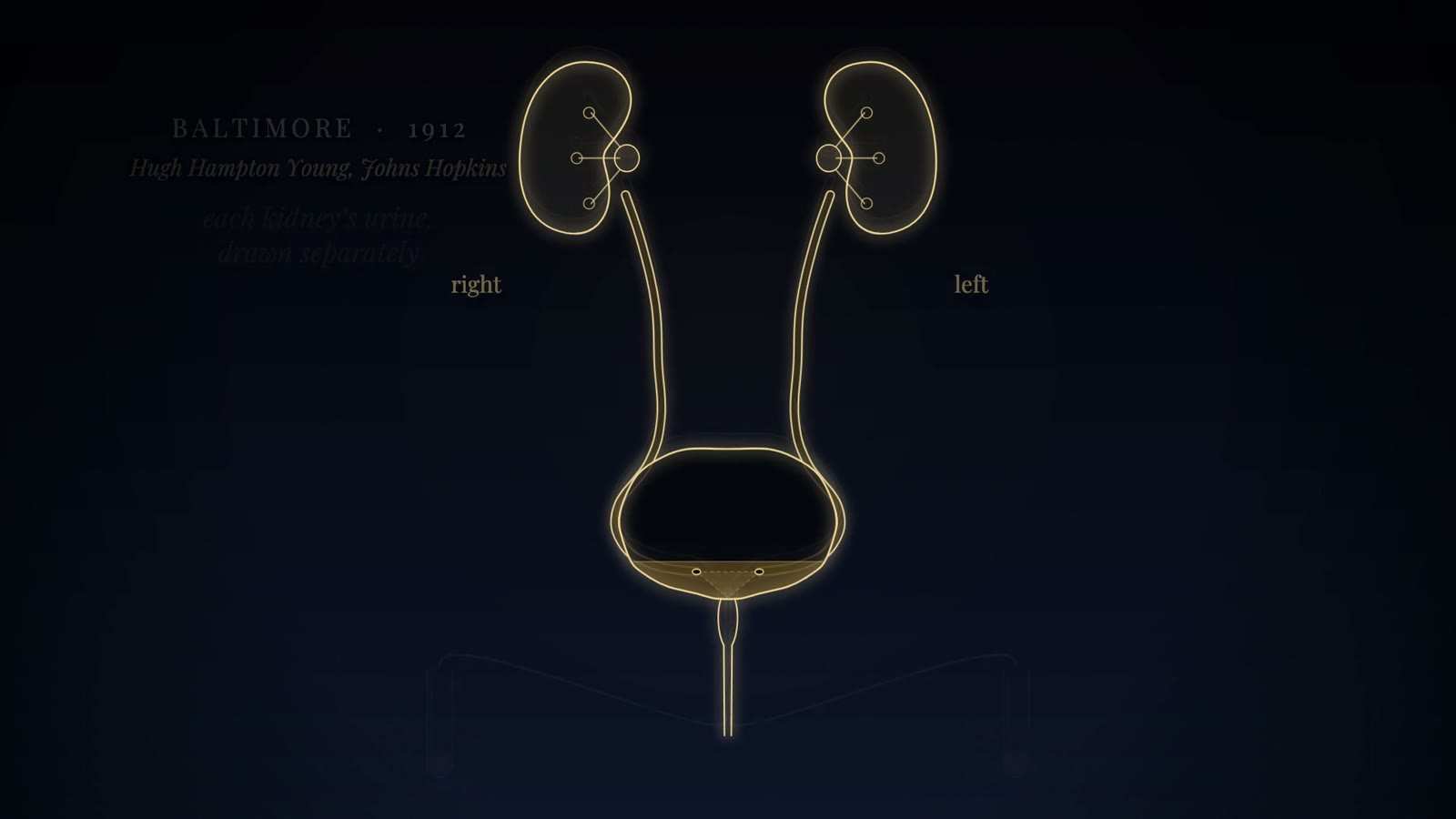
In 1912 Hugh Hampton Young passed a rigid paediatric cystoscope up the severely dilated ureter of a child with posterior urethral valves. Bagley's history calls it the first ureteroscopy; it was reported in 1929, in a review of congenital urethral valves. probable
Sources- Bagley, History of Ureteroscopy, in Ureteroscopy: A Comprehensive Contemporary Guide (Springer) Secondary
- Bagley chapter text: history of the development of ureteral endoscopy Secondary
- Whitehurst LA, Somani BK. Urolithiasis 2018 (as cited in dossier 03; no URL in the kit) Secondary
Dossier 04 rests the case on Bagley's chapter alone and grades it probable. Whitehurst and Somani (dossier 03) agree on the year, the paediatric cystoscope, the dilated ureter and the 1929 report with McKay, and add that the scope reached the renal pelvis, which dossier 04 does not accept. The child's age is not verified, and no cited source places the case at Johns Hopkins. The 1929 report (Young and McKay, Surg Gynecol Obstet) was not seen.
-
Wilhelm Conrad Röntgen discovered X-rays at Würzburg on 8 November 1895; his paper appeared on 28 December 1895. probable
Sources- English Wikipedia entry on Wilhelm Conrad Röntgen, as cited in dossier 04 §6.1 (no URL given in the kit) Secondary
Single cited source (English Wikipedia, no URL in the kit). The dossier's second source, the AUA imaging page, also has no URL in the kit.
-
John Macintyre of Glasgow Royal Infirmary is credited with the first X-ray of a kidney stone in place in the body, and in 1896 he opened what is credited as the first hospital X-ray department.
Sources- RCPSG heritage blog: Glasgow's contribution to radiology Museum or society
- Urology News: Early British pioneers of urological imaging Secondary
The department opened with the managers' permission in March 1896. No cited source dates the stone radiograph; the day often given (2 April 1896) rests on a single page and is not used.
-
Henry Morris, in Surgical Diseases of the Kidney and Ureter (1904), warned that X-rays might put back renal surgery by deterring patients from surgical exploration. probable
Sources- Urology News: Early British pioneers of urological imaging Secondary
- H. Morris, Surgical Diseases of the Kidney and Ureter (1904), as quoted in Urology News; the original page was not seen by the dossier Primary
Known through a quotation in Urology News; the dossier did not see the original. How far Morris welcomed the rays is a matter of reading; see the debate and conflicts.
-
Urology News describes Henry Morris as a pioneer of nephrolithotomy who, in 1904, still preferred exploratory surgery. probable
SourcesThe film's date (1880) and its statement that this was the first operation of its kind are not in the kit; see gaps. The dossier gives his life dates (1844 to 1926) without a source.
-
In 1906 Friedrich Voelcker and Alexander von Lichtenberg, at Heidelberg, filled the renal pelvis with Collargol, a colloidal silver preparation, through a ureteral catheter and radiographed it.
Sources- Wikipedia (de): Friedrich Voelcker Secondary
- Wikipedia (de): Alexander von Lichtenberg Secondary
- Moll F, Friedrich Voelcker, Alexander v. Lichtenberg: Pyelographie, Aktuelle Urologie 1995;26:70-74, doi:10.1055/s-2008-1057777 Secondary
- Urology News: Early British pioneers of urological imaging Secondary
The usual citation (Münch med Wochenschr 1906;53:105) was not seen. That the method needed a cystoscopy each time is the dossier's own statement, not a source's; see gaps.
-
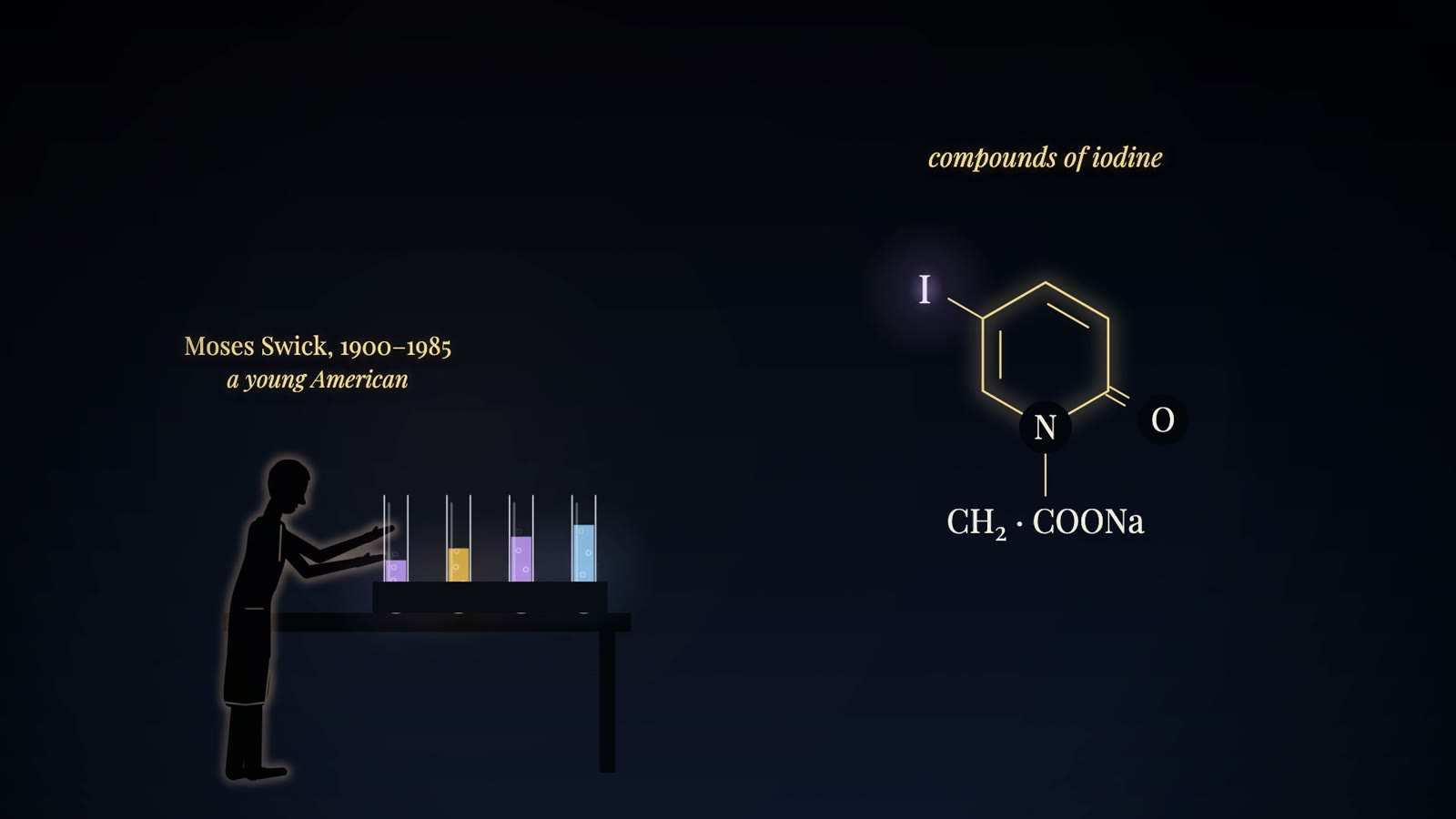
The chemists Arthur Binz and Curt Räth made iodinated pyridine compounds as anti-infectives. In 1929 Moses Swick reported that one derived from them, Uroselectan, injected into a vein, showed the kidney and urinary tract on X-ray, and with von Lichtenberg reported its clinical testing.
Sources- Hierholzer and Hierholzer 2002, The discovery of renal contrast media in Berlin, Am J Nephrol (PubMed) Secondary
- Wikipedia (de): Arthur Binz Secondary
- Swick 1929, Darstellung der Niere und Harnwege im Röntgenbild durch intravenöse Einbringung eines neuen Kontraststoffes, des Uroselectans, Klin Wochenschr 8:2087-2089 Primary
- von Lichtenberg and Swick 1929, Klinische Prüfung des Uroselectans, Klin Wochenschr 8:2089-2091 Primary
The two 1929 papers are known from their published titles (Crossref); the chemistry rests on Hierholzer and Hierholzer (2002) and the German Wikipedia article on Binz. Swick was born in New York in 1900 (German Wikipedia; Loughlin and Hawtrey 2003). Chemically, Uroselectan is the sodium salt of 5-iodo-2-pyridone-N-acetic acid.
-
Swick tested the Binz and Räth compounds in the clinics of Leopold Lichtwitz (Altona, Hamburg) and Alexander von Lichtenberg (St Hedwig, Berlin) and found that the kidneys excreted them rapidly; an iodinated N-acetylated derivative, later named Uroselectan, gave X-ray contrast after intravenous injection. probable
SourcesSingle secondary source (Hierholzer and Hierholzer 2002) for where Swick worked, the rapid renal excretion and the derivative.
-
Von Lichtenberg, the professor in whose clinic Swick worked, presented the discovery at meetings, first in Munich in 1929 and then at the AUA in 1930, and Swick received little credit. probable
SourcesThe meetings and the lack of credit rest on two German Wikipedia articles; the dossier's other source, the AUA Didusch page, has no URL in the kit and is not cited alone. That Swick worked in von Lichtenberg's clinic rests on Hierholzer and Hierholzer (2002). The screenplay note agrees on Munich 1929 and the AUA 1930.
-
The New York Academy of Medicine awarded Swick its Valentine Medal in 1966. probable
Sources- Wikipedia (de): Moses Swick Secondary
Single cited source (German Wikipedia); the dossier's other source, the AUA Didusch page, has no URL in the kit. That the award followed an inquiry by Victor F. Marshall rests on the AUA page alone and is not used.
-
Von Lichtenberg was dismissed from all his posts in 1936 because of his Jewish ancestry; he emigrated via Budapest to Mexico in 1939 and died there in 1949. probable
SourcesSingle source (German Wikipedia). Lichtwitz was forced out in 1933. Binz, as general secretary of the German Chemical Society from 1932 to 1937, was instrumental in dismissing its Jewish employees.
-
In January 1954 Harold Hopkins and Narinder Kapany published in Nature a flexible fibrescope: an ordered (coherent) bundle of glass fibres that carried an image along a bent path.
SourcesAbraham van Heel of Delft published in the same issue.
-
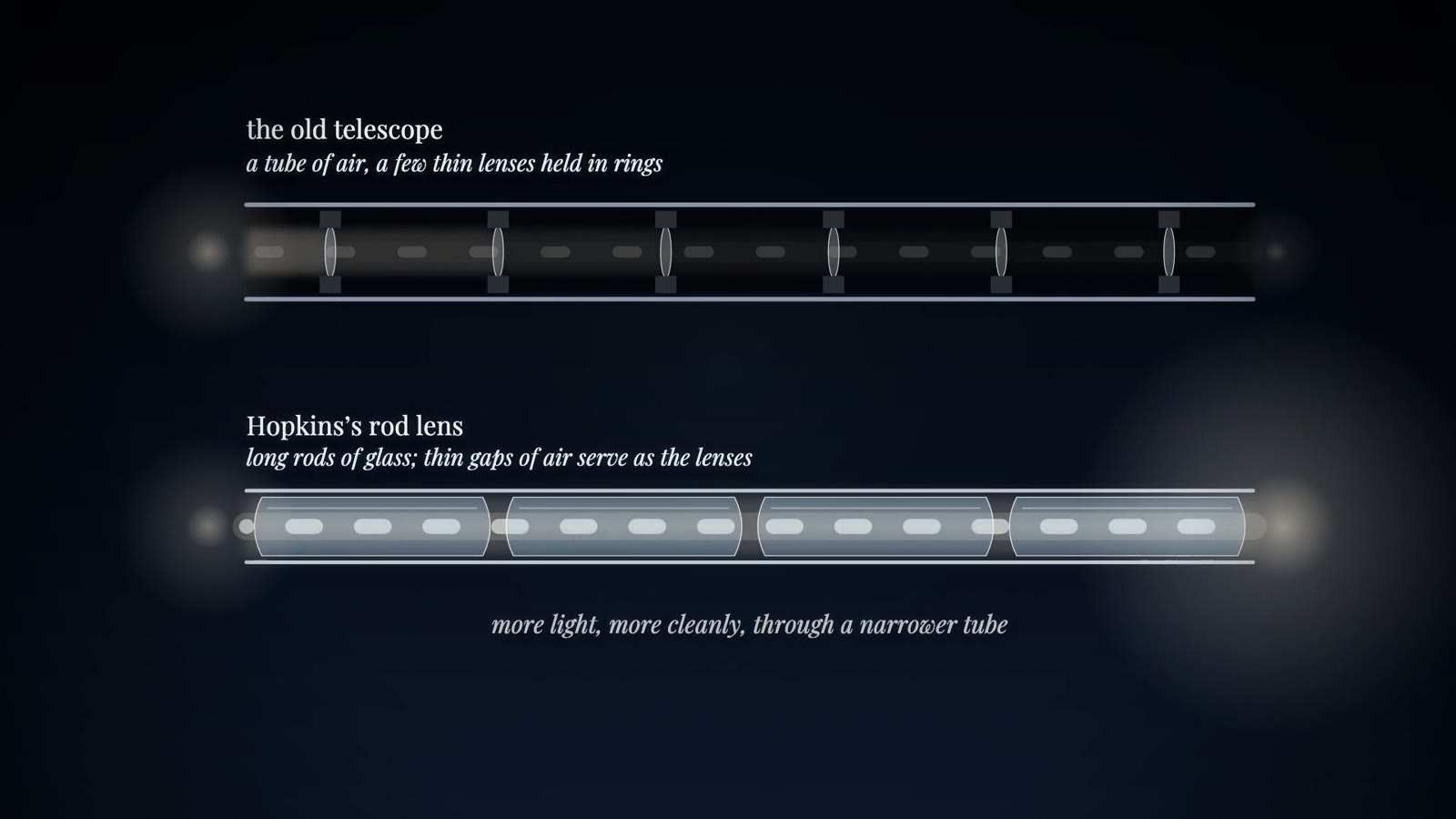
Hopkins's rod-lens patent describes rod-like biconvex glass lenses set end to end, each longer than the air space that separates them, so that the glass provides most of the optical path. The British application (GB 954,629) was filed on 16 July 1959.
SourcesThe GB abridgement claims 'at least two rod-like biconvex lenses arranged end to end in separated relationship'; the US patent (filed 14 July 1960) adds that the lenses provide 'the major part of the length of the optical path'. The film's description of the air gaps as the lenses is the dossier's plain-language gloss, not the patents' wording; see conflicts.
-
The gain in light transmission from the rod-lens system is given as up to about eighty times. probable
Sources- Harold Hopkins Society history page (archived) Museum or society
- Wikipedia: Harold Hopkins (physicist) Secondary
Both accounts are secondary and the original measurement was not found; the film attributes the figure ('by one account').
-
Hopkins approached British cystoscope makers without success. probable
Sources- Harold Hopkins Society history page (archived) Museum or society
The Hopkins Society says UK and US makers would not invest.
-
The Hopkins-Storz rod-lens cystoscope with cold light, from the firm of Karl Storz of Tuttlingen, was presented at the SIU congress in Munich in 1967.
Sources- Wikipedia (de): Karl Storz (Unternehmer) Secondary
- BAUS Virtual Museum: Cystoscopy Museum or society
- Harold Hopkins Society history page (archived) Museum or society
- Fuchs 2006, Surg Endosc 20 Suppl 2:S493-9 (PubMed) Secondary
The German Wikipedia article dates Storz's external cold-light source, carried by fibre-optic cable, from 1960. George Berci acted as go-between for Hopkins and Storz (Fuchs; Hopkins Society).
-
Wallace (1973) observed that bringing the light back outside the body returned endoscopy, in a sense, to Bozzini's arrangement. probable
SourcesSingle secondary source, paraphrased in dossier 04 §3.4. The film's 'eighty years inside the bladder' is the dossier's own count, from Nitze's tip lamp of 1879 to external fibre-optic light (Storz, from 1960) and Hopkins optics (1967); no source states the span. See gaps.
Myths corrected
-
Unresolved. The Lichtleiter was made of silver covered with sharkskin (or, in other accounts, lead covered with leather).
-
Half true. Vienna rejected Bozzini's Lichtleiter.
-
False. Bozzini died aged 36.
-
Unsupported as a quotation. The Vienna faculty dismissed the Lichtleiter as 'a magic lantern in the human body'.
-
False. Desormeaux invented the endoscope in 1865.
-
False. Nitze was the first to put electric light inside the body.
-
False. Nitze's 1879 cystoscope was lit by Edison's light bulb.
-
False. Edison's light bulb dates from 1887.
-
Embellished. Young's 1912 cystoscope reached the renal pelvis of a child of stated age, and the case was published at once.
-
Legend. On seeing the X-ray of her hand, Anna Bertha Röntgen exclaimed, 'I have seen my death!'
-
False. Swick alone invented Uroselectan; or, von Lichtenberg invented intravenous urography.
-
False. Hopkins invented fibre optics single-handed, including glass cladding in 1951.
-
False. Karl Storz invented the rod lens.
-
False. Bozzini was born in 1779 and died in 1807.
-
Unsupported. The Vienna faculty reprimanded Bozzini for 'undue curiosity' (or 'morbid curiosity').
-
Unsupported. Bozzini looked into the male bladder, so the first cystoscopy was his.
-
Loose. The first cystoscopy took place in 1807 at the Academy of Medicine in Vienna.
-
Speculation. A British soldier stole the original Lichtleiter from Vienna in 1945.
-
Half true. David Newman of Glasgow built the first incandescent-lamp cystoscope in 1883.
-
False. Nitze was 28 at his 1877 Dresden demonstration.
-
False. Basil Hirschowitz invented the flexible endoscope alone in 1957.
-
Half true. The rod lens was patented in 1960.